Introduction to Kali-Based Commands

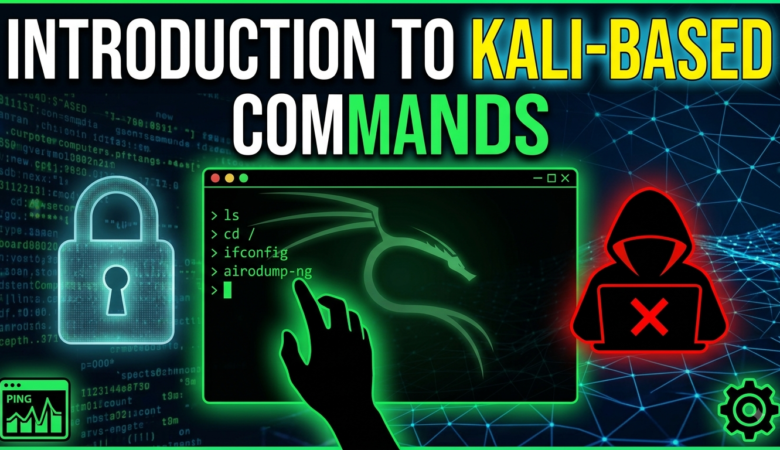
Introduction to Kali-Based Commands Abstract Kali Linux is a Debian-based operating system widely used in cybersecurity, penetration testing, digital forensics, network security, and security research. One of the most important skills for a new Kali Linux user is learning how to work with the command line. Although Kali provides a graphical desktop environment, many administrative and cybersecurity tasks are performed more efficiently through terminal commands. This article provides an introduction to commonly used Kali-based Linux commands and explains their practical importance. It discusses commands for navigating directories, managing files, searching information, checking network configuration, monitoring processes, managing permissions, and installing software. The purpose is not to cover every command available in Kali Linux, but to establish a basic command-line foundation for students who are beginning their study of cybersecurity. Understanding these commands can make it easier to use specialized security tools and can also improve a user’s general understanding of how a Linux system operates. Keywords: Kali Linux, Linux commands, cybersecurity, terminal, penetration testing, file management, network security 1. Introduction Kali Linux has become an important operating system in the field of cybersecurity. It is developed and maintained by Offensive Security and is based on Debian Linux. The distribution contains a large collection of tools designed for activities such as penetration testing, security auditing, digital forensics, vulnerability research, and network analysis. However, simply installing Kali Linux does not mean that a person understands how to use it effectively. A basic understanding of Linux and its command-line environment is necessary before moving toward more advanced security activities. The command line is one of the most powerful features of a Linux system. Instead of depending entirely on graphical menus, users can type commands directly into a terminal and communicate with the operating system. Commands can be used to create and manage files, navigate directories, examine system information, manage software, check network configurations, and monitor running processes. For cybersecurity students, command-line knowledge is particularly valuable. Many security tools available in Kali Linux are operated from the terminal. A person who understands basic commands can focus more easily on understanding what a security tool is doing instead of struggling with basic Linux operations. This article introduces some important Kali-based commands and explains their purpose. The examples are intended for legitimate educational use, such as working on a personal computer, virtual machine, or authorized cybersecurity laboratory. 2. Kali Linux and the Command-Line Environment Kali Linux provides both a graphical user interface and a command-line interface. The graphical environment can be convenient for everyday tasks, but the terminal provides greater flexibility and control. A terminal command normally contains a command name and may include options or arguments. For example: ls -l Here, ls is the command and -l is an option that changes the way information is displayed. Learning commands is not simply about memorizing their names. A user should understand what each command does, what options are available, and what effect the command may have on the system. This becomes particularly important when administrative privileges are involved. 3. Navigating the File System Linux organizes information in a hierarchical file system. Users need to understand this structure before they can work comfortably from the terminal. 3.1 The pwd Command The pwd command means “print working directory.” It shows the directory in which the user is currently working. pwd A possible result could be: /home/student This tells the user that the current working directory is the student directory inside /home. The command is especially useful for beginners because it removes uncertainty about the current location in the file system. 3.2 The ls Command The ls command lists files and directories. ls A more detailed listing can be displayed with: ls -l Hidden files can be included with: ls -la The detailed output can provide information about file permissions, ownership, size, and modification time. This makes ls one of the commands that users will probably use most frequently. 3.3 The cd Command The cd command is used to change the current directory. cd Documents To move to the parent directory: cd .. The home directory can be accessed with: cd ~ The root of the file system can be reached with: cd / A good understanding of cd is essential because many other commands operate on the current working directory. 4. Managing Files and Directories File management is another fundamental part of working with Kali Linux. 4.1 Creating Directories with mkdir The mkdir command creates a new directory. mkdir cybersecurity This creates a directory called cybersecurity. A student could use this command to create separate folders for assignments, laboratory exercises, scripts, and research material. 4.2 Creating Files with touch The touch command can create an empty file. touch notes.txt This creates a file named notes.txt. It is a simple command, but it is frequently used when working with shell scripts, configuration files, notes, and testing environments. 4.3 Copying Files with cp The cp command copies files. cp notes.txt backup.txt This creates a second copy called backup.txt. Directories can also be copied when the appropriate recursive option is used: cp -r project project_backup Creating backups is particularly important before modifying configuration files. 4.4 Moving and Renaming Files with mv The mv command can move a file to another location: mv notes.txt Documents/ It can also rename a file: mv old.txt new.txt This makes mv useful for organizing files and maintaining a clean working environment. 4.5 Removing Files with rm The rm command removes files. rm notes.txt Directories can be removed with suitable options, for example: rm -r old_directory Users should be especially careful with this command. Unlike a graphical recycle bin, removing files through rm may not provide an easy method of recovery. It is therefore important to verify the target before executing a destructive command. 5. Reading and Searching Information Cybersecurity work often involves examining text files, logs, configuration files, and command output. Several Linux commands are useful for this purpose. 5.1 The cat Command The cat command displays the contents of a text file. cat notes.txt


Cybersecurity in Industrial Piping Systems

Cybersecurity in Industrial Piping Systems Abstract Modern industrial piping systems are no longer limited to physical pipes, valves, pumps, tanks, and mechanical equipment. Many modern facilities use computerized control systems to monitor pressure, temperature, flow rate, valve positions, alarms, and other important operating conditions. These systems improve efficiency and safety, but they also introduce cybersecurity risks. If an industrial control system or pipeline monitoring network is accessed by an unauthorized person, the consequences can be much more serious than the loss of ordinary computer data. Changes to a control system may affect physical equipment, production processes, environmental safety, and even human life. Ethical hacking provides a controlled way of identifying cybersecurity weaknesses before they are exploited by criminals. This article introduces ethical hacking and explains its importance in industrial piping and pipeline environments. It discusses industrial control systems, SCADA, common cybersecurity risks, the role of ethical hackers, security testing methods, human factors, legal responsibilities, and the future of cybersecurity in industrial piping systems. Keywords: Ethical Hacking, Piping, Pipeline Security, Cybersecurity, SCADA, Industrial Control Systems, ICS, Network Security, Industrial Automation 1. Introduction Piping is an important part of many industrial facilities. Oil and gas plants, chemical industries, power stations, water-treatment facilities, refineries, manufacturing plants, and other industries depend on piping systems to transport liquids, gases, steam, chemicals, and other materials from one location to another. In the past, piping systems were mainly considered a mechanical and physical engineering subject. Engineers were concerned with pipe materials, pressure, temperature, flow, valves, pumps, fittings, corrosion, and maintenance. Today, however, many industrial piping systems are connected to digital monitoring and control technologies. Modern facilities use sensors and computerized systems to monitor conditions inside pipelines and process equipment. Operators may be able to see pressure, temperature, flow, tank levels, valve conditions, and alarms from a control room. In some facilities, control systems can also automatically adjust valves, pumps, and other equipment. This development has improved industrial operations, but it has also created another type of risk: cybersecurity risk. If an attacker gains unauthorized access to an industrial control system, they may be able to interfere with the operation of equipment. In a piping environment, such interference could potentially affect pressure, flow, valves, pumps, or other process conditions. Therefore, protecting industrial piping systems is not only a matter of mechanical safety. It can also involve cybersecurity. Ethical hacking can help organizations identify weaknesses in these digital systems in a controlled and authorized manner. 2. What Is Ethical Hacking? Ethical hacking is the authorized process of examining computer systems, networks, applications, and digital devices to identify security weaknesses. An ethical hacker works with permission from the organization that owns the system. The purpose is to discover vulnerabilities and help fix them before malicious attackers can take advantage of them. The word “ethical” is important. Testing a computer system or industrial network without permission can be illegal and dangerous. Ethical hackers must work within a clearly defined scope. For example, an industrial company may hire cybersecurity professionals to assess the security of a monitoring network connected to a pipeline. The security team may examine how the system is configured, how users are authenticated, and how different parts of the network communicate. The objective is not to shut down the pipeline or interfere with its normal operation. Instead, the goal is to identify weaknesses safely and provide recommendations for improving security. Ethical hackers are often called white hat hackers. They use hacking knowledge for defensive purposes. This is different from black hat hackers, who may access systems without permission to steal information, cause damage, or gain financial benefits. 3. Connection Between Ethical Hacking and Piping At first, ethical hacking and piping may appear to be completely different subjects. Piping is associated with physical infrastructure, while ethical hacking is associated with computers. However, modern industrial environments connect these two areas through automation and control systems. A pipeline may contain sensors that measure pressure, temperature, and flow. These sensors send information to computerized control systems. Operators use this information to understand what is happening inside the process. Automated valves may also be controlled electronically. Pumps can be monitored and, in some systems, adjusted through control systems. Alarms can notify operators when conditions move outside normal operating ranges. This means that a modern piping system can have both physical components and digital components. The physical side includes pipes, valves, pumps, tanks, fittings, and instruments. The digital side can include sensors, programmable logic controllers, supervisory systems, communication networks, servers, and operator workstations. If the digital side is not properly protected, it may create risks for the physical side. This is why cybersecurity knowledge is becoming increasingly relevant to students and professionals working around industrial piping systems. 4. Industrial Control Systems Industrial Control Systems, commonly called ICS, are used to monitor and control industrial processes. An ICS environment can include different types of equipment and technologies. One important component is the Programmable Logic Controller (PLC). PLCs are commonly used to control industrial equipment and processes. Another important technology is SCADA, which stands for Supervisory Control and Data Acquisition. SCADA systems are used in many industrial environments to collect information from field equipment and provide operators with a way to monitor and control processes. In a piping or pipeline environment, a control system may receive information about flow, pressure, temperature, and valve status. Operators can use this information to make decisions about the operation of the system. Because these systems interact with physical processes, cybersecurity must be approached carefully. A problem with an ordinary office computer may result in lost files or temporary inconvenience. A problem with an industrial control system could potentially affect physical equipment or safety conditions. 5. Why Cybersecurity Is Important in Piping Systems The main purpose of industrial cybersecurity is to protect systems from unauthorized access, manipulation, disruption, and other threats. Consider a pipeline carrying a hazardous material. Its operation may depend on sensors, valves, pumps, and control systems. If an attacker were able to interfere with the digital systems controlling

Why Cybersecurity Matters More Than Ever in 2026

Why Cybersecurity Matters More Than Ever in 2026 A Data-Driven Report Table of Content: 1-Introduction: 2 2-The Economics of Cybercrime Have Reached a Tipping Point: 2 3-Ransomware Is Faster, More Frequent, and More Costly: 3 4-Attackers Have Moved Beyond Malware: 4 5-Artificial Intelligence Is Reshaping Both Sides of the Fight: 5 6-Detection Is Still Too Slow: 6 7-Defenders Are Responding – But the Gap Persists: 7 8-Small Businesses Remain Disproportionately Exposed: 8 9-Conclusion: 8 10-References: 8 Introduction: Cybersecurity is no longer a background IT concern; it is a determining factor in whether businesses stay solvent, hospitals keep operating, and everyday consumers can trust the digital systems they rely on. By 2026, the scale of cybercrime has grown so large that it now behaves less like a technical nuisance and more like a structural feature of the global economy. This report draws on recent industry data, from CrowdStrike, Statista, Cybersecurity Ventures, IBM, and multiple 2026 industry statistics roundups, to explain why cybersecurity matters more in 2026 than at any previous point, and what specifically has changed to make the stakes so much higher. The Economics of Cybercrime Have Reached a Tipping Point: The clearest evidence that cybersecurity has become an economic issue, not just a technical one, is the sheer cost of cybercrime. Global cybercrime losses reached an estimated $10.5 trillion in 2025 and are projected to climb toward $15.63 trillion by 2029, according to Statista-sourced industry figures. If cybercrime were measured as a national economy, these figures would already place it among the largest in the world, ahead of the GDP of most countries. This growth is not gradual background noise; it reflects a compounding trend as more of the global economy, commerce, healthcare, infrastructure, and personal life, moves online and becomes a viable target. Figure 1: Projected global cost of cybercrime, 2025–2029 (source: Statista, via CDNetworks 2026 report) In direct response, global information security spending is projected to reach $183.9 billion in 2026, a 15 percent year-over-year increase. That spending increase is itself a signal: organizations are no longer treating security as a fixed-percentage line item but as a rapidly scaling cost center, because the alternative, absorbing breach costs and reputational damage, has become more expensive than prevention. Ransomware Is Faster, More Frequent, and More Costly: Ransomware remains the single most disruptive category of cyberattack, and its pace is accelerating sharply. In 2021, a ransomware attack struck a business or consumer somewhere in the world roughly every 11 seconds. Cybersecurity Ventures projects that by 2031 this will compress to every 2 seconds, equivalent to over 43,000 attacks per day. Annual global damage from multi-stage ransomware extortion, attacks that combine encryption with data theft and public leak threats, is forecast to reach $74 billion in 2026 alone. Figure 2: Ransomware attack frequency is compressing from once every 11 seconds (2021) toward once every 2 seconds (2031 projected). The nature of ransomware has also shifted. Roughly half of current attacks now go beyond simple file encryption, combining data theft and extortion specifically to defeat organizations that believe backups alone are sufficient protection. Healthcare has emerged as the costliest target, with breaches in that sector averaging an estimated $12.6 million per incident, far above the global cross-industry average, reflecting both the sensitivity of medical data and the operational danger of disrupting patient care systems. Attackers Have Moved Beyond Malware: One of the most consequential shifts heading into 2026 is that most attacks no longer rely on malicious software at all. CrowdStrike’s 2026 Cyber Threats Report found that 82 percent of detected intrusions were malware-free, meaning they relied instead on phishing, social engineering, stolen credentials, and abuse of legitimate trusted access. This proportion has risen steadily and sharply: from 40 percent in 2019, to 62 percent in 2021, to 75 percent in 2023, to 82 percent by 2026. Figure 3: The share of detected attacks that are malware-free has more than doubled since 2019 (source: CrowdStrike Global Threat Report, via NU and PreVeil 2026 statistics). This trend matters because it exposes the limits of traditional, signature-based antivirus and malware-scanning defenses. If an attacker never installs malicious code and instead logs in using a stolen or phished credential, most legacy security tools have nothing to detect. It is a core reason the industry has shifted its emphasis toward identity governance, multi-factor authentication, and zero trust architectures, treating every access request as unverified by default rather than trusting anything already inside the network perimeter. Artificial Intelligence Is Reshaping Both Sides of the Fight: AI has become a genuine double-edged sword in cybersecurity by 2026. On the offensive side, the FBI’s Internet Crime Complaint Center recorded more than 22,000 AI-related complaints in 2025 alone, with adjusted losses exceeding $893 million, covering AI-generated phishing content, deepfake-based fraud, and automated vulnerability discovery. Concern about this shift is widespread: 87 percent of surveyed organizations now identify AI-related vulnerabilities as their fastest-growing category of cyber risk, and the share of people actively assessing the security of AI tools they use nearly doubled in a single year, from 37 percent in 2025 to 64 percent in 2026. On the defensive side, AI-powered security tools are scaling just as quickly: the global AI cybersecurity market is projected to exceed $133 billion by 2030, and organizations that adopt AI-driven detection and automated response report average breach-cost savings of roughly $2.2 million annually, through faster detection, faster containment, and reduced need for manual security operations work. The net effect is that AI is simultaneously making attacks cheaper and faster to launch and making sophisticated defense more accessible, an arms race playing out inside nearly every organization’s security stack simultaneously. Figure 4: Global security spending, the zero trust market, and the AI cybersecurity market are all expanding rapidly (source: ORDR 2026 Threat Data Report). Detection Is Still Too Slow: Despite rising investment, the gap between attack and detection remains dangerously wide. Organizations require an average of 277 days to identify and contain a security incident, nearly nine months during which attackers can move laterally,

Linux Basic & Advanced Commands

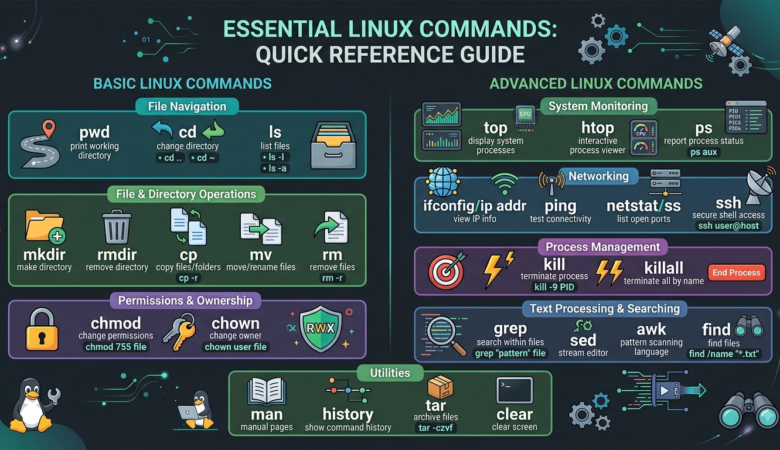
Linux Basic & Advanced Commands Abstract Linux is one of the most widely used operating systems in the field of information technology and cybersecurity. Its flexibility, powerful command-line environment, and large collection of security tools make it an important platform for students and professionals who want to understand ethical hacking. Ethical hacking is the authorized process of examining computer systems, networks, and applications to identify security weaknesses before they can be misused by attackers. Linux commands are especially useful in this field because they allow security professionals to interact directly with files, processes, networks, users, and system configurations. This article introduces the concept of ethical hacking and explains its connection with Linux. It also discusses the role of basic and advanced Linux commands in security testing, common Linux tools used by ethical hackers, system administration, networking, file management, permissions, process monitoring, and security analysis. The article also explains the importance of legal permission and responsible use of Linux security tools. Keywords: Ethical Hacking, Linux, Cybersecurity, Linux Commands, Network Security, Terminal, Penetration Testing, System Security 1. Introduction Computers and networks are now an important part of almost every organization. Businesses, universities, banks, hospitals, government departments, and many other organizations depend on computer systems to store information and provide services. Because so much information is stored digitally, protecting these systems has become a major concern. Cybercriminals are constantly looking for weaknesses in computer systems. They may try to steal passwords, access private information, install malicious software, or interrupt services. Organizations therefore need security professionals who can understand how attacks work and identify weaknesses before criminals can use them. This is where ethical hacking comes into the picture. Ethical hacking is the authorized testing of computer systems and networks to find security weaknesses. An ethical hacker uses security knowledge and techniques similar to those used by attackers, but the main difference is that the ethical hacker has permission from the owner of the system. The purpose is to improve security rather than cause damage. Linux has an important place in ethical hacking and cybersecurity. Unlike some operating systems where users mainly depend on graphical interfaces, Linux provides a powerful command-line environment. Through the terminal, users can perform a wide range of tasks quickly and precisely. They can examine files, manage users, monitor processes, check network connections, change permissions, search system information, and perform many other administrative and security-related tasks. For students studying Linux basic and advanced commands, learning about ethical hacking provides a practical reason for understanding the command line. Linux commands are not only useful for normal system administration; they are also important tools for security professionals. 2. What Is Ethical Hacking? Ethical hacking is the practice of examining a computer system, network, or application for security weaknesses with proper authorization. For example, a company may ask a security professional to test its Linux server. The tester may check system configurations, user permissions, network services, software versions, and other security-related areas. If a weakness is found, the tester reports it to the organization so that it can be fixed. The word “ethical” is important because hacking without permission can be illegal. A person should not scan or attempt to access another person’s computer simply because they have the technical ability to do so. Ethical hackers are often called white hat hackers. They use their skills to protect systems. In comparison, black hat hackers access systems without authorization and may use their skills for theft, fraud, damage, or other criminal activities. There are also grey hat hackers, who may find vulnerabilities without having proper permission. Even if they do not intend to cause harm, unauthorized access can still create legal and ethical problems. Therefore, ethical hacking is not simply about knowing hacking commands. It involves technical knowledge, permission, responsibility, and proper use of security skills. 3. Why Linux Is Important in Ethical Hacking Linux is popular among cybersecurity professionals for several reasons. One of the biggest advantages is its command-line interface. The terminal allows users to communicate directly with the operating system. Instead of navigating through multiple graphical menus, a user can enter a command and immediately perform a task. Linux also provides extensive control over files, users, processes, permissions, and network configurations. This makes it useful for security testing and system administration. Another reason is the availability of cybersecurity distributions such as Kali Linux and Parrot Security OS. These distributions contain many tools designed for security testing, digital forensics, network analysis, and penetration testing. Linux is also widely used for servers. Web servers, database servers, cloud systems, and network services often run on Linux. Therefore, someone interested in cybersecurity benefits from understanding how Linux systems operate. For a student learning Linux commands, ethical hacking provides a practical environment in which those commands become useful. 4. Basic Linux Commands and Their Security Importance Learning basic Linux commands is the first step toward becoming comfortable with the Linux terminal. The pwd command displays the current working directory. It is useful when working with files because it tells the user where they currently are in the file system. The ls command displays files and directories. Options can be used to display additional information, including hidden files and file permissions. The cd command is used to move between directories. Understanding directory navigation is important because security professionals often need to examine different locations within a Linux system. The mkdir command creates a new directory, while touch can be used to create a file. The cp command copies files and directories, and mv moves or renames them. The rm command removes files or directories, so it should be used carefully. The cat command can display the contents of a file. Commands such as head and tail are useful when only the beginning or end of a file needs to be viewed. These commands may appear simple, but they form the foundation of Linux system administration. A cybersecurity student needs to be comfortable with them before moving to more advanced tasks. 5. Linux File Permissions and Ethical

INTRODUCTION TO ETHICAL HACKING

INTRODUCTION TO ETHICAL HACKING A Research Article for Networking Abstract The use of computer networks has increased rapidly over the past few years. Almost every organization today depends on networks to communicate, share information, provide services, and connect users with digital resources. Along with these developments, network security has become an important concern. Attackers are always looking for weaknesses in networks that can be used to gain unauthorized access, steal information, or interrupt services. Ethical hacking is one of the methods used to identify and understand these weaknesses before they are exploited by criminals. Ethical hackers test computer systems and networks with proper permission and report the weaknesses they find. This article provides an introduction to ethical hacking, its importance in networking, different types of hackers, common areas of security testing, the basic ethical hacking process, required skills, legal responsibilities, and its role in protecting modern networks. Keywords: Ethical Hacking, Networking, Cyber Security, Network Security, White Hat Hacker, Vulnerability, Penetration Testing 1. Introduction Computer networking has become a basic part of modern technology. Computers are no longer used as separate machines. They are connected through local networks, wireless networks, the internet, cloud platforms, and other communication systems. These connections allow people to share files, communicate with each other, access websites, use online applications, and share resources from different locations. Although networking provides many benefits, it also creates security risks. When computers and devices are connected to a network, there are more possible ways for an unauthorized person to attempt to access them. A weak password, an incorrectly configured device, outdated software, or an insecure network service can sometimes become an entry point for an attacker. This is where ethical hacking becomes useful. Ethical hacking is the process of checking computer systems, networks, applications, and devices for security weaknesses with the permission of the owner. An ethical hacker uses security testing techniques to think about how an attacker might approach a system. The main purpose is to discover weaknesses and help the organization fix them. The word “hacking” is often connected with illegal activities. However, not every hacker has criminal intentions. Ethical hackers use similar technical knowledge for a completely different purpose. They are hired by organizations to strengthen security rather than steal information or damage systems. For networking students, ethical hacking is an important topic because network security and ethical hacking are closely connected. Understanding how attacks can happen helps network professionals design and maintain safer networks. 2. What Is Ethical Hacking? Ethical hacking is an authorized attempt to identify security weaknesses in a computer system or network. The person performing the test is normally given permission by the organization before starting the assessment. For example, imagine that a company has a network connecting hundreds of computers, servers, printers, and other devices. The company may hire an ethical hacker to check whether someone could gain unauthorized access to the network. The ethical hacker examines the network, identifies possible weaknesses, and prepares a report for the company. The purpose is not to damage the network or steal information. Instead, the purpose is to understand where security improvements are needed. One of the most important concepts in ethical hacking is authorization. A person should not test a network simply because they can access it. Permission must be obtained from the owner, and the scope of the testing should be clearly defined. Ethical hackers are commonly known as white hat hackers. They use their knowledge to improve security. This makes them different from black hat hackers, who access systems without permission for harmful or illegal purposes. 3. Importance of Ethical Hacking in Networking Ethical hacking is especially important in networking because networks connect many different systems and devices. If an attacker gains access to one part of a network, they may attempt to reach other systems. Network security involves protecting devices, connections, communication channels, and information from unauthorized access. Ethical hacking helps organizations check whether their existing security measures are actually working as expected. For example, a network may have a firewall installed, but simply having a firewall does not guarantee complete security. Incorrect configuration, unnecessary open services, weak access controls, or outdated software may still create security problems. An ethical hacker can examine these areas and identify possible weaknesses. Ethical hacking can also help organizations understand their real security condition. Security policies may look good in documents, but practical testing can reveal problems that are difficult to notice during normal network administration. Another important benefit is prevention. Finding a vulnerability before an attacker discovers it gives the organization an opportunity to correct the problem. This can reduce the possibility of data theft, network disruption, and financial loss. 4. Types of Hackers Hackers are generally divided into different categories according to their intentions and activities. 4.1 White Hat Hackers White hat hackers are ethical hackers. They have permission to test systems and networks. Their goal is to identify vulnerabilities and help organizations improve security. They normally work for cybersecurity companies, technology organizations, government departments, or as independent security professionals. 4.2 Black Hat Hackers Black hat hackers are individuals who access systems without authorization. Their activities may involve stealing information, spreading malware, committing fraud, damaging systems, or demanding money from victims. Their actions are illegal and can cause serious damage to organizations and individuals. 4.3 Grey Hat Hackers Grey hat hackers are sometimes described as being between white hat and black hat hackers. They may discover vulnerabilities without receiving proper permission. They may not always have malicious intentions, but unauthorized access can still create legal and security problems. The main lesson is that good intentions do not automatically make unauthorized hacking legal or ethical. 5. Ethical Hacking and Network Security Ethical hacking and network security are closely related. Network security focuses on protecting network infrastructure and the information moving through it, while ethical hacking can be used to test whether those protections are effective. A network can contain many components, including routers, switches, firewalls, servers, wireless access points, computers, and mobile devices. Each