
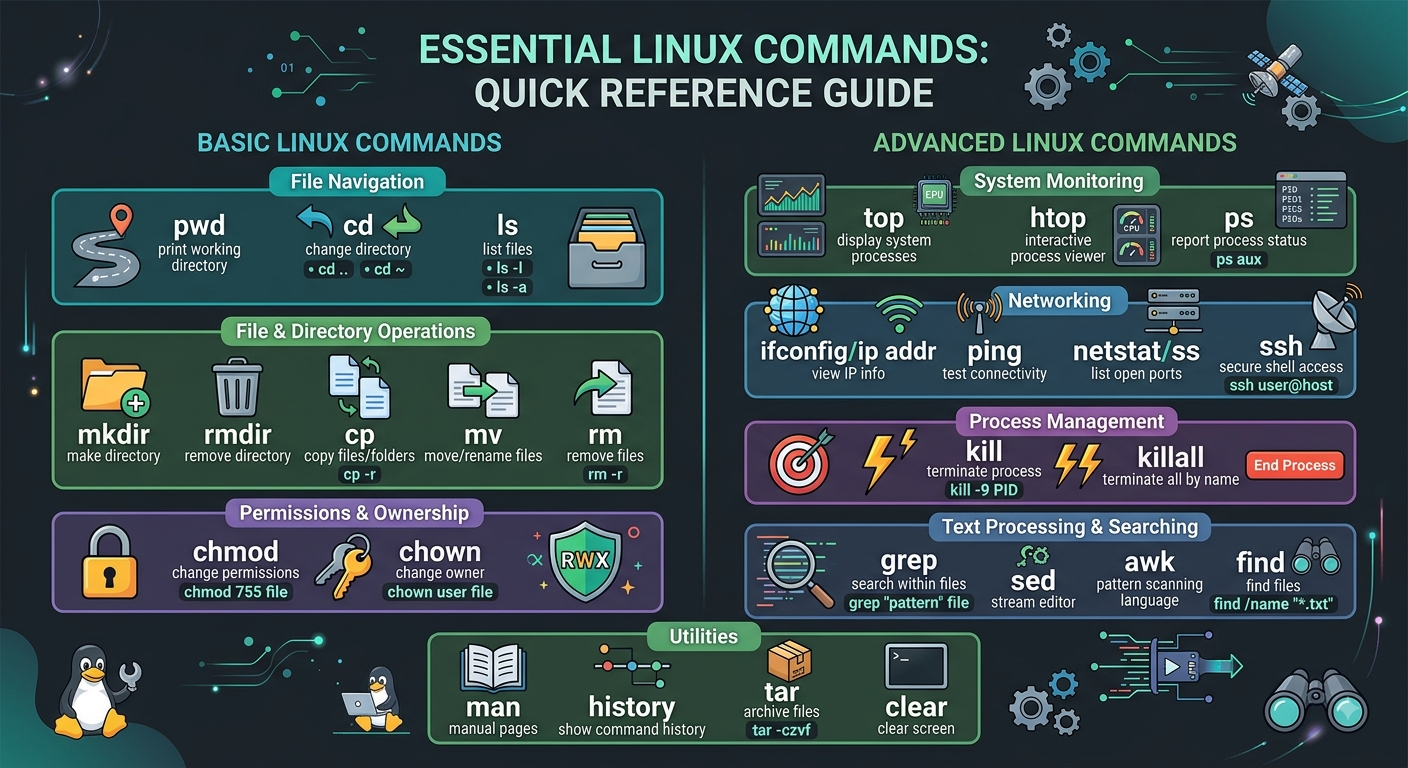
Linux Basic & Advanced Commands
Linux Basic & Advanced Commands
Abstract
Linux is one of the most widely used operating systems in the field of information technology and cybersecurity. Its flexibility, powerful command-line environment, and large collection of security tools make it an important platform for students and professionals who want to understand ethical hacking. Ethical hacking is the authorized process of examining computer systems, networks, and applications to identify security weaknesses before they can be misused by attackers. Linux commands are especially useful in this field because they allow security professionals to interact directly with files, processes, networks, users, and system configurations. This article introduces the concept of ethical hacking and explains its connection with Linux. It also discusses the role of basic and advanced Linux commands in security testing, common Linux tools used by ethical hackers, system administration, networking, file management, permissions, process monitoring, and security analysis. The article also explains the importance of legal permission and responsible use of Linux security tools.
Keywords: Ethical Hacking, Linux, Cybersecurity, Linux Commands, Network Security, Terminal, Penetration Testing, System Security
1. Introduction
Computers and networks are now an important part of almost every organization. Businesses, universities, banks, hospitals, government departments, and many other organizations depend on computer systems to store information and provide services. Because so much information is stored digitally, protecting these systems has become a major concern.
Cybercriminals are constantly looking for weaknesses in computer systems. They may try to steal passwords, access private information, install malicious software, or interrupt services. Organizations therefore need security professionals who can understand how attacks work and identify weaknesses before criminals can use them.
This is where ethical hacking comes into the picture.
Ethical hacking is the authorized testing of computer systems and networks to find security weaknesses. An ethical hacker uses security knowledge and techniques similar to those used by attackers, but the main difference is that the ethical hacker has permission from the owner of the system. The purpose is to improve security rather than cause damage.
Linux has an important place in ethical hacking and cybersecurity. Unlike some operating systems where users mainly depend on graphical interfaces, Linux provides a powerful command-line environment. Through the terminal, users can perform a wide range of tasks quickly and precisely. They can examine files, manage users, monitor processes, check network connections, change permissions, search system information, and perform many other administrative and security-related tasks.
For students studying Linux basic and advanced commands, learning about ethical hacking provides a practical reason for understanding the command line. Linux commands are not only useful for normal system administration; they are also important tools for security professionals.
2. What Is Ethical Hacking?
Ethical hacking is the practice of examining a computer system, network, or application for security weaknesses with proper authorization.
For example, a company may ask a security professional to test its Linux server. The tester may check system configurations, user permissions, network services, software versions, and other security-related areas. If a weakness is found, the tester reports it to the organization so that it can be fixed.
The word “ethical” is important because hacking without permission can be illegal. A person should not scan or attempt to access another person’s computer simply because they have the technical ability to do so.
Ethical hackers are often called white hat hackers. They use their skills to protect systems. In comparison, black hat hackers access systems without authorization and may use their skills for theft, fraud, damage, or other criminal activities.
There are also grey hat hackers, who may find vulnerabilities without having proper permission. Even if they do not intend to cause harm, unauthorized access can still create legal and ethical problems.
Therefore, ethical hacking is not simply about knowing hacking commands. It involves technical knowledge, permission, responsibility, and proper use of security skills.
3. Why Linux Is Important in Ethical Hacking
Linux is popular among cybersecurity professionals for several reasons. One of the biggest advantages is its command-line interface.
The terminal allows users to communicate directly with the operating system. Instead of navigating through multiple graphical menus, a user can enter a command and immediately perform a task.
Linux also provides extensive control over files, users, processes, permissions, and network configurations. This makes it useful for security testing and system administration.
Another reason is the availability of cybersecurity distributions such as Kali Linux and Parrot Security OS. These distributions contain many tools designed for security testing, digital forensics, network analysis, and penetration testing.
Linux is also widely used for servers. Web servers, database servers, cloud systems, and network services often run on Linux. Therefore, someone interested in cybersecurity benefits from understanding how Linux systems operate.
For a student learning Linux commands, ethical hacking provides a practical environment in which those commands become useful.
4. Basic Linux Commands and Their Security Importance
Learning basic Linux commands is the first step toward becoming comfortable with the Linux terminal.
The pwd command displays the current working directory. It is useful when working with files because it tells the user where they currently are in the file system.
The ls command displays files and directories. Options can be used to display additional information, including hidden files and file permissions.
The cd command is used to move between directories. Understanding directory navigation is important because security professionals often need to examine different locations within a Linux system.
The mkdir command creates a new directory, while touch can be used to create a file.
The cp command copies files and directories, and mv moves or renames them. The rm command removes files or directories, so it should be used carefully.
The cat command can display the contents of a file. Commands such as head and tail are useful when only the beginning or end of a file needs to be viewed.
These commands may appear simple, but they form the foundation of Linux system administration. A cybersecurity student needs to be comfortable with them before moving to more advanced tasks.
5. Linux File Permissions and Ethical Hacking
File permissions are one of the most important Linux concepts for security.
Linux uses permissions to control who can read, write, or execute files. Permissions are generally associated with three categories: the owner, the group, and others.
The ls -l command can be used to view file permissions. A permission string may show whether a file can be read, written, or executed by different users.
The chmod command is used to change permissions. The chown command can change the owner of a file, while chgrp can change its group.
Understanding permissions is important for ethical hacking because incorrectly configured permissions can expose sensitive information.
For example, if a confidential file is readable by every user on a system when it should only be accessible to an administrator, that represents a security weakness.
Ethical hackers and Linux administrators can check permissions and recommend safer configurations.
6. User and Account Management
User accounts are another important part of Linux security.
Commands such as whoami can show the current username, while id can display information about the current user’s identity and group memberships.
The who command can provide information about users currently logged into a system. The passwd command is used to manage passwords.
Linux also has powerful account and privilege management features. The sudo command allows authorized users to execute certain commands with elevated privileges.
Understanding privileges is extremely important in cybersecurity. A normal user should not automatically have administrative access to every part of the system.
From an ethical hacking perspective, excessive privileges can become a security concern. If a normal account has more access than necessary, an attacker who obtains that account could potentially cause greater damage.
This is why the principle of least privilege is important. Users should generally receive only the permissions required to perform their jobs.
7. Process Management and System Monitoring
Linux systems run many processes in the background. Understanding these processes is useful for both system administration and cybersecurity.
The ps command can display information about running processes. The top command provides a continuously updated view of system activity. Some Linux systems also provide the htop utility, which offers an interactive process-monitoring interface.
The kill command can be used to send signals to processes when appropriate.
Security professionals may use process monitoring to investigate unusual system behavior. For example, if an unfamiliar process is consuming a large amount of CPU or memory, an administrator may investigate what program started it and why it is running.
Process monitoring is therefore an important part of understanding what is happening inside a Linux system.
8. Linux Networking Commands
Networking knowledge is essential for ethical hacking, and Linux provides many useful commands for network analysis.
The ip command is widely used to view and manage network interfaces and addresses. It can provide information about network configuration.
The ping command can be used to test basic connectivity between systems. The ss command can display network sockets and connections.
The curl command is commonly used to communicate with web servers and retrieve information from URLs. It is useful for testing web services and understanding HTTP communication.
The traceroute utility can help show the path network traffic takes toward a destination, although its availability and exact behavior can vary between systems.
These commands are useful for learning how computers communicate across networks. They can also assist administrators and security professionals when investigating network problems.
9. Advanced Linux Commands and Security
After learning basic commands, students can move toward more advanced Linux techniques.
Commands such as grep, awk, sed, sort, and find are particularly useful for searching and processing information.
For example, grep can search text for specific patterns. This can be useful when examining system logs for particular messages or events.
The find command can search for files based on different conditions. Security professionals may use it during authorized system audits to locate files that meet specific criteria.
Linux also provides powerful shell features that allow commands to be combined using pipes. A pipe allows the output of one command to be used as the input of another command.
This ability to combine commands is one of the strengths of Linux. Instead of relying on one large application, a user can combine smaller utilities to perform a specific task.
Shell scripting takes this idea further. A security professional can create scripts to automate repetitive administrative or monitoring tasks. However, scripts should always be used responsibly and tested carefully.
10. Linux Tools Used in Ethical Hacking
Linux-based security environments contain many tools used by cybersecurity professionals.
Nmap is widely used for network discovery and security auditing. It can help identify hosts and services during authorized assessments.
Wireshark is used to analyze network traffic. It can help security professionals understand how data is moving across a network and investigate unusual traffic.
Burp Suite is commonly used for web application security testing. It allows testers to examine communication between web browsers and applications.
Metasploit is a security testing framework that can be used in authorized penetration-testing environments.
There are also tools for password auditing, vulnerability assessment, digital forensics, wireless security testing, and other areas of cybersecurity.
Students should remember that learning these tools is not the same as learning cybersecurity. A tool may produce information, but the user needs sufficient knowledge to understand what that information means.
11. Linux Logs and Security Monitoring
System logs are valuable sources of information for Linux administrators and security professionals.
Logs can contain information about system events, authentication attempts, services, errors, and other activities. Examining logs can help identify unusual behavior.
Linux provides different locations and mechanisms for system logging depending on the distribution and configuration. Tools such as journalctl can be used on systems using systemd to examine journal entries.
For example, an administrator may investigate repeated failed login attempts or unusual service activity. Log analysis can help determine whether an event is normal or requires further investigation.
This is an important connection between Linux commands and cybersecurity. Security is not only about preventing attacks; it is also about recognizing suspicious activity when it occurs.
12. Ethical and Legal Responsibilities
Learning Linux security commands comes with responsibility. Security tools and commands should only be used in authorized environments.
Students can practice safely using their own computers, virtual machines, cybersecurity laboratories, or training platforms specifically designed for security education.
A common mistake among beginners is assuming that scanning a system is harmless because they are not actually stealing anything. In reality, unauthorized security testing can still create problems and may violate laws or organizational policies.
Ethical hackers must understand the limits of their authorization. They should know what systems they are allowed to test, what techniques are permitted, and how information discovered during the assessment should be handled.
The goal of ethical hacking is to improve security, not to demonstrate that someone can break into a system.
13. Importance of Linux Knowledge for Cybersecurity Students
For students studying cybersecurity or networking, Linux knowledge can provide a strong foundation.
Linux teaches students how operating systems work at a deeper level. Working with the terminal encourages users to understand files, permissions, processes, networking, services, and system configurations.
These concepts are directly connected to cybersecurity.
For example, understanding Linux permissions makes it easier to understand access-control problems. Learning networking commands helps students understand network communication. Learning process management helps them recognize unusual system activity. Learning logs helps them understand security monitoring.
Linux also encourages problem-solving. When a command does not work, students often need to investigate the error, check documentation, examine configuration files, and try another approach.
These skills are valuable beyond Linux itself.
14. Future of Linux and Ethical Hacking
Linux is likely to remain important in cybersecurity because it is widely used in servers, cloud computing, networking, embedded systems, and security tools.
As organizations move more services to cloud environments, Linux knowledge will continue to be useful. Many cloud servers and infrastructure systems are based on Linux.
Cybersecurity itself is also changing. Artificial intelligence, automation, Internet of Things devices, container technology, and cloud platforms are creating new security challenges.
Ethical hackers will need to understand these technologies and learn how security problems can occur within them.
For students, this means that learning Linux commands should not be treated as memorizing a list of commands for an examination. The more useful approach is to understand what each command does and why it might be useful.
15. Conclusion
Ethical hacking is an important area of cybersecurity, and Linux plays a major role in developing practical security skills. Linux provides users with a powerful command-line environment for managing systems, examining files, monitoring processes, checking networks, analyzing logs, and performing many other tasks.
Basic commands such as ls, cd, pwd, cp, mv, and cat provide the foundation. Commands related to permissions, users, processes, networking, and logs take that knowledge further. Advanced tools and security frameworks can then be studied in controlled and authorized environments.
For students of Linux Basic & Advanced Commands, understanding ethical hacking gives a practical meaning to the commands they learn. Instead of viewing commands as separate pieces of information, students can see how they are used to understand and protect real computer systems.
At the same time, technical ability must be combined with responsibility. Linux security tools can be powerful, and using them against systems without permission is not ethical hacking.
In the end, ethical hacking is about finding weaknesses so they can be corrected. Linux provides many of the tools and skills needed to understand systems at a deeper level. By learning Linux commands, networking concepts, system administration, and ethical security practices together, students can build a strong foundation for further study in cybersecurity.
The most important lesson is that cybersecurity is not simply about knowing how to attack a computer. It is about understanding how systems work, recognizing where they can become vulnerable, and using that knowledge responsibly to make them safer.