
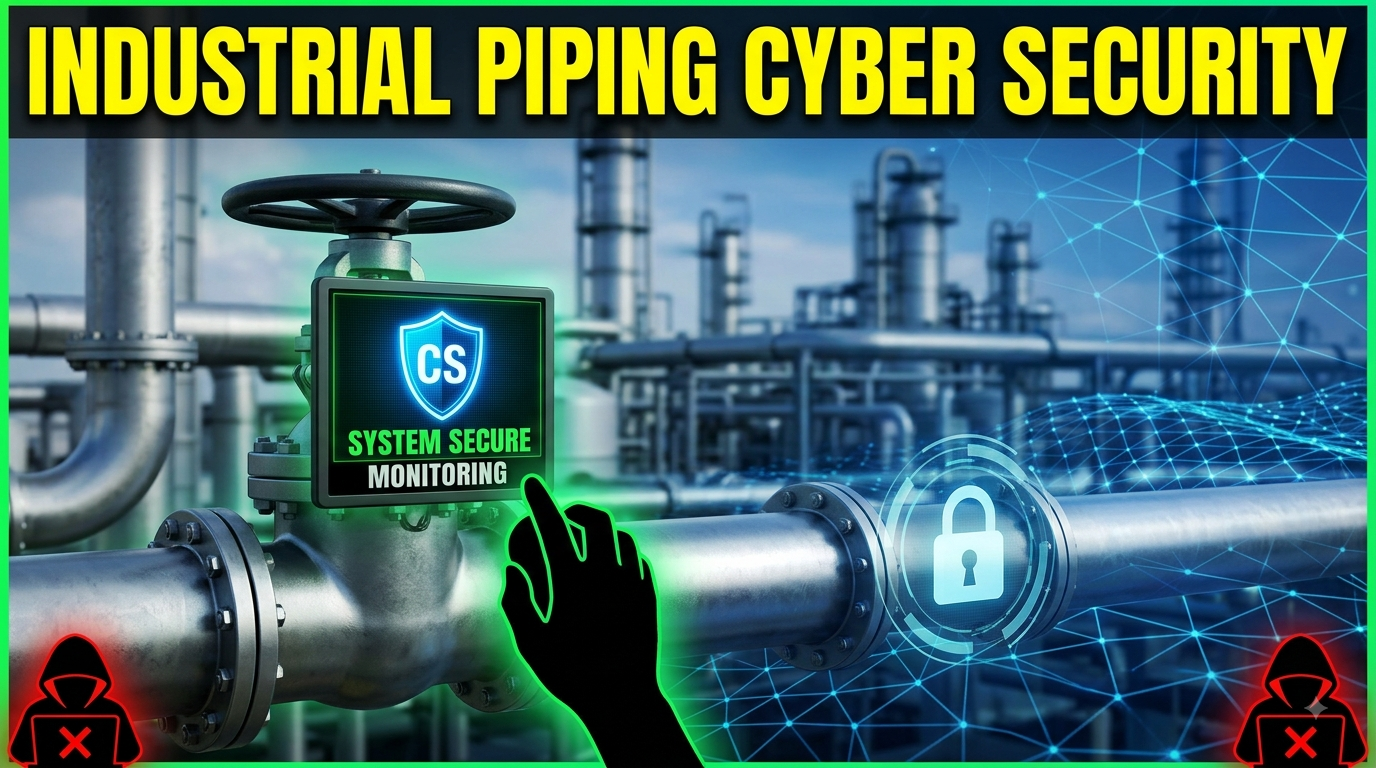
Cybersecurity in Industrial Piping Systems
Cybersecurity in Industrial Piping Systems
Abstract
Modern industrial piping systems are no longer limited to physical pipes, valves, pumps, tanks, and mechanical equipment. Many modern facilities use computerized control systems to monitor pressure, temperature, flow rate, valve positions, alarms, and other important operating conditions. These systems improve efficiency and safety, but they also introduce cybersecurity risks. If an industrial control system or pipeline monitoring network is accessed by an unauthorized person, the consequences can be much more serious than the loss of ordinary computer data. Changes to a control system may affect physical equipment, production processes, environmental safety, and even human life. Ethical hacking provides a controlled way of identifying cybersecurity weaknesses before they are exploited by criminals. This article introduces ethical hacking and explains its importance in industrial piping and pipeline environments. It discusses industrial control systems, SCADA, common cybersecurity risks, the role of ethical hackers, security testing methods, human factors, legal responsibilities, and the future of cybersecurity in industrial piping systems.
Keywords: Ethical Hacking, Piping, Pipeline Security, Cybersecurity, SCADA, Industrial Control Systems, ICS, Network Security, Industrial Automation
1. Introduction
Piping is an important part of many industrial facilities. Oil and gas plants, chemical industries, power stations, water-treatment facilities, refineries, manufacturing plants, and other industries depend on piping systems to transport liquids, gases, steam, chemicals, and other materials from one location to another.
In the past, piping systems were mainly considered a mechanical and physical engineering subject. Engineers were concerned with pipe materials, pressure, temperature, flow, valves, pumps, fittings, corrosion, and maintenance. Today, however, many industrial piping systems are connected to digital monitoring and control technologies.
Modern facilities use sensors and computerized systems to monitor conditions inside pipelines and process equipment. Operators may be able to see pressure, temperature, flow, tank levels, valve conditions, and alarms from a control room. In some facilities, control systems can also automatically adjust valves, pumps, and other equipment.
This development has improved industrial operations, but it has also created another type of risk: cybersecurity risk.
If an attacker gains unauthorized access to an industrial control system, they may be able to interfere with the operation of equipment. In a piping environment, such interference could potentially affect pressure, flow, valves, pumps, or other process conditions. Therefore, protecting industrial piping systems is not only a matter of mechanical safety. It can also involve cybersecurity.
Ethical hacking can help organizations identify weaknesses in these digital systems in a controlled and authorized manner.
2. What Is Ethical Hacking?
Ethical hacking is the authorized process of examining computer systems, networks, applications, and digital devices to identify security weaknesses.
An ethical hacker works with permission from the organization that owns the system. The purpose is to discover vulnerabilities and help fix them before malicious attackers can take advantage of them.
The word “ethical” is important. Testing a computer system or industrial network without permission can be illegal and dangerous. Ethical hackers must work within a clearly defined scope.
For example, an industrial company may hire cybersecurity professionals to assess the security of a monitoring network connected to a pipeline. The security team may examine how the system is configured, how users are authenticated, and how different parts of the network communicate.
The objective is not to shut down the pipeline or interfere with its normal operation. Instead, the goal is to identify weaknesses safely and provide recommendations for improving security.
Ethical hackers are often called white hat hackers. They use hacking knowledge for defensive purposes. This is different from black hat hackers, who may access systems without permission to steal information, cause damage, or gain financial benefits.
3. Connection Between Ethical Hacking and Piping
At first, ethical hacking and piping may appear to be completely different subjects. Piping is associated with physical infrastructure, while ethical hacking is associated with computers. However, modern industrial environments connect these two areas through automation and control systems.
A pipeline may contain sensors that measure pressure, temperature, and flow. These sensors send information to computerized control systems. Operators use this information to understand what is happening inside the process.
Automated valves may also be controlled electronically. Pumps can be monitored and, in some systems, adjusted through control systems. Alarms can notify operators when conditions move outside normal operating ranges.
This means that a modern piping system can have both physical components and digital components.
The physical side includes pipes, valves, pumps, tanks, fittings, and instruments. The digital side can include sensors, programmable logic controllers, supervisory systems, communication networks, servers, and operator workstations.
If the digital side is not properly protected, it may create risks for the physical side.
This is why cybersecurity knowledge is becoming increasingly relevant to students and professionals working around industrial piping systems.
4. Industrial Control Systems
Industrial Control Systems, commonly called ICS, are used to monitor and control industrial processes.
An ICS environment can include different types of equipment and technologies. One important component is the Programmable Logic Controller (PLC). PLCs are commonly used to control industrial equipment and processes.
Another important technology is SCADA, which stands for Supervisory Control and Data Acquisition. SCADA systems are used in many industrial environments to collect information from field equipment and provide operators with a way to monitor and control processes.
In a piping or pipeline environment, a control system may receive information about flow, pressure, temperature, and valve status. Operators can use this information to make decisions about the operation of the system.
Because these systems interact with physical processes, cybersecurity must be approached carefully. A problem with an ordinary office computer may result in lost files or temporary inconvenience. A problem with an industrial control system could potentially affect physical equipment or safety conditions.
5. Why Cybersecurity Is Important in Piping Systems
The main purpose of industrial cybersecurity is to protect systems from unauthorized access, manipulation, disruption, and other threats.
Consider a pipeline carrying a hazardous material. Its operation may depend on sensors, valves, pumps, and control systems. If an attacker were able to interfere with the digital systems controlling these components, the consequences could potentially be serious.
Cybersecurity is therefore connected to several important goals.
The first is safety. Industrial processes must operate within safe pressure, temperature, and flow limits. Security controls can help reduce the possibility of unauthorized changes to these systems.
The second is availability. Industrial systems often need to operate continuously. A cyberattack that interrupts monitoring or control could affect production.
The third is integrity. Operators need accurate information. If a monitoring system displays incorrect information, operators may make decisions based on false data.
The fourth is confidentiality. Industrial facilities may contain sensitive information about processes, equipment, designs, and operations. Protecting this information is also important.
6. Common Cybersecurity Risks in Industrial Piping
Industrial piping environments can face several cybersecurity risks.
One risk is unauthorized access. Weak passwords, poorly managed accounts, or unnecessary remote access can create opportunities for attackers.
Another risk is outdated software. Industrial systems may remain in operation for many years. Replacing or updating equipment can be expensive, so older systems may continue to operate even when their software needs security improvements.
Poor network configuration is another concern. If industrial control networks are not properly separated from office networks or external networks, an attacker who compromises one system may have opportunities to reach another.
Phishing and social engineering can also affect industrial organizations. Employees may receive fake emails or messages designed to steal login information. A compromised employee account can become a starting point for a larger attack.
There are also risks from removable devices. USB drives and other portable storage devices can potentially introduce malicious software into systems if they are not properly controlled.
These risks demonstrate why industrial cybersecurity requires both technical protection and employee awareness.
7. Role of Ethical Hackers in Industrial Security
Ethical hackers can help industrial organizations identify cybersecurity weaknesses before criminals exploit them.
Their work may include reviewing network architecture, checking access controls, examining system configurations, and identifying outdated or unnecessary services.
However, ethical hacking in an industrial environment requires more caution than testing an ordinary computer network.
Industrial systems often control real physical processes. An aggressive security test could potentially interrupt operations or cause unexpected behavior. For this reason, security assessments should be carefully planned.
Testing may be performed in a separate laboratory or test environment whenever possible. If testing must be performed on an operational system, the organization needs to establish strict rules and safety procedures.
The ethical hacker must understand that protecting human safety and industrial operations is more important than demonstrating a technical capability.
8. Network Segmentation and Piping Security
Network segmentation is an important security concept for industrial environments.
In a well-designed industrial network, different systems may be separated according to their purpose and level of trust. Office computers, control systems, monitoring systems, and external connections should not necessarily have unrestricted access to one another.
For example, an industrial control network may be separated from a company’s normal office network using appropriate security architecture.
This separation can reduce the potential impact of a compromised office computer. Even if an employee’s computer becomes infected, strong network segmentation can make it more difficult for an attacker to reach sensitive industrial systems.
Ethical hackers can evaluate whether network segmentation is working as intended during an authorized security assessment.
9. Human Factors in Industrial Cybersecurity
Technology is only one part of cybersecurity. People also play an important role.
Employees may unintentionally create security risks by using weak passwords, sharing login information, opening suspicious attachments, or connecting unauthorized devices to industrial systems.
Training can help employees recognize suspicious activity and understand proper security procedures.
For example, employees working in a control room should understand why unauthorized USB devices should not be connected to industrial computers. They should also know how to report suspicious messages or unusual system behavior.
Ethical security assessments can sometimes include authorized awareness exercises. The purpose is to identify weaknesses in organizational procedures and improve employee training.
A strong security system therefore depends on people, technology, and proper procedures working together.
10. Ethical Hacking Methodology
Ethical hacking in an industrial environment should begin with planning.
The organization and security team should determine which systems are included in the assessment, what activities are allowed, and when testing can take place.
The next step is information gathering. The security team develops an understanding of the network, systems, devices, and communication paths.
After that, the team can perform controlled security analysis. They may examine configurations, authentication methods, network exposure, and known vulnerabilities.
If the assessment permits controlled exploitation, it should be performed carefully and only when the potential effect on industrial operations is understood.
The final stage is reporting. The ethical hacker documents the weaknesses discovered and explains their potential impact.
Recommendations should then be provided. These may include improving access controls, separating networks, updating systems where practical, improving monitoring, or providing additional employee training.
11. Importance of SCADA Security
SCADA systems are particularly important in pipeline and industrial environments.
A SCADA system may allow operators to monitor equipment from a central location. In large pipeline networks, operators may need information from equipment located across considerable distances.
This creates a strong need for reliable communication and secure access.
If an unauthorized person gains access to a SCADA environment, they may potentially obtain sensitive operational information or attempt to interfere with control functions.
For this reason, organizations need strong authentication, access control, network protection, monitoring, and incident-response procedures.
Ethical security assessments can help identify weaknesses in the architecture surrounding SCADA systems without unnecessarily disrupting operations.
12. Legal and Ethical Responsibilities
Ethical hacking must always be performed with authorization.
This is particularly important in industrial environments because the systems being tested may control equipment that can affect people, property, and the environment.
A security professional should clearly understand the scope of the assessment before beginning.
They should also protect confidential information discovered during testing. Industrial facilities may contain sensitive information about equipment, processes, designs, and operations.
Another important responsibility is safety. Security testing should never be performed in a way that creates unnecessary danger.
An ethical hacker’s goal is not to prove that they can break a system. The goal is to help the organization identify and reduce security risks.
13. Challenges of Ethical Hacking in Piping Industries
Industrial cybersecurity presents several challenges.
One challenge is the age of some industrial equipment. Industrial systems are often designed to operate for many years, and replacing older equipment may be expensive and difficult.
Another challenge is downtime. A normal office computer can sometimes be taken offline for maintenance, but shutting down an industrial process may have significant financial and operational consequences.
There is also a difference between IT systems and industrial control systems. Traditional IT security practices cannot always be applied directly to operational technology because the priorities and risks can be different.
In an industrial environment, safety and continuous operation are extremely important.
For this reason, cybersecurity professionals working in piping and process industries need to understand both technology and industrial operations.
14. Future of Cybersecurity in Piping
The connection between piping and digital technology is likely to become stronger in the future.
Industrial facilities are increasingly using automation, remote monitoring, smart sensors, data analysis, and other digital technologies. These technologies can improve efficiency and help operators identify problems earlier.
However, increased connectivity also means that cybersecurity needs to receive greater attention.
Artificial intelligence and advanced analytics may help organizations identify unusual network behavior and detect possible security incidents. At the same time, attackers may also use advanced technologies to develop more sophisticated methods.
Future industrial professionals will therefore need to understand the relationship between physical systems and cybersecurity.
Piping students may not become cybersecurity specialists, but having a basic understanding of industrial cybersecurity can help them work more safely in modern facilities.
15. Conclusion
Ethical hacking is usually associated with computers and networks, but its importance extends into industrial environments where digital systems are connected to physical equipment. Modern piping and pipeline facilities use sensors, PLCs, SCADA systems, communication networks, and computerized control systems to monitor and manage industrial processes.
This connection creates new cybersecurity responsibilities.
A cyberattack against an industrial control system can potentially have consequences beyond lost computer data. Depending on the system and circumstances, unauthorized changes could affect equipment, production, safety, or the environment. Ethical hacking provides organizations with a controlled method of identifying security weaknesses before malicious attackers can exploit them.
For professionals and students associated with piping, understanding basic industrial cybersecurity is becoming increasingly useful. Knowledge of SCADA, industrial networks, access control, network segmentation, and security awareness can complement traditional knowledge of pipes, valves, pumps, pressure, flow, and process equipment.
Ethical hacking should always be performed with proper authorization and careful planning. Industrial systems require additional caution because security testing can interact with real physical processes.
In conclusion, cybersecurity is becoming an important part of modern piping and pipeline operations. The future of industrial safety will depend not only on strong mechanical design and proper maintenance, but also on protecting the digital systems that monitor and control these facilities. Ethical hacking can play an important role in that protection by helping organizations discover weaknesses, improve their defenses, and make industrial operations more secure and reliable.