

Web Penetration Testing: Complete Guide to Web Application Security
Web penetration testing
Web penetration testing is an authorized, simulated cyberattack on a web application. Ethical security professionals use it to find flaws, misconfigurations, and design weaknesses
Beginner Roadmap: From Recon to Server-Side Attacks
2-What is web penteration testing? 2
3-The web pentesting roadmap: 3
Phase 1: Reconnaissance – The Foundation 3
Phase 2: Authentication Assessment 4
Phase 3: Session Management: 4
Phase 4: Authorization – The Permission Gap: 4
Phase 5: Client-Side Vulnerabilities: 5
Phase 6: Server-Side Vulnerabilities 5
4-Key tools used in web pentesting: 6
5-Importance of web pentesting in 2026: 6
6-Ethical and Legal Considerations: 7
7-Conclusion:………………………………………………………………………………………………………………………. 7
8-References:……………………………………………………………………………………………………………………….. 8
Introduction:
Web penetration testing is commonly known as web pentesting. It is a structured and authorized process of probing web applications for security vulnerabilities before malicious attackers can exploit them. In the era of digital internet continues to evolve rapidly, web applications have become the primary interface between businesses and customers. Therefore, the most targeted layer of any organization’s is digital infrastructure.
This report is based on the Web pentesting beginner roadmap (2026): From Recon to server-side attacks, this report provides a concise, structured methodology for aspiring penetration tester and bug bounty hunters. This report expends with deeper explanations, real world context, and academic analysis of each phase.
A structured reference guide for anyone who just finished their first web security course
What is web penteration testing?
Web penetration testing is the practice of simulating real-world cyberattacks on a web application with the explicit written permission of the application owner. The goal is to identify vulnerabilities, weaknesses in code, configuration, or design. It produce a detailed report so they can be fixed before a real attacker exploits them.
Key purposes include:
- Identifying security flaws in web applications before attackers do.
- Helping developers understand how their code can be exploited in practice.
- Meeting compliance and regulatory requirements (e.g., PCI-DSS, ISO 27001, GDPR).
- Supporting bug bounty programs with structured vulnerability reports.
- Improving the overall security posture of an organization.
The web pentesting roadmap:
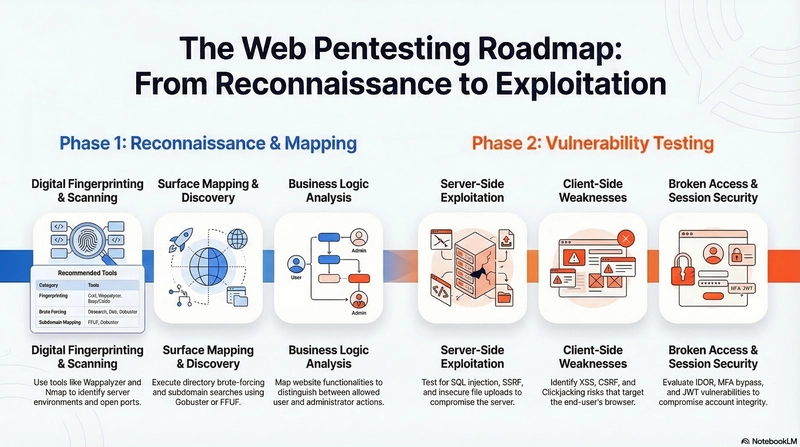
Here’s six core phases of web penetration test. Each phase builds upon the previous one for identifying and ethically exploiting vulnerabilities.
Phase 1: Reconnaissance – The Foundation
Reconnaissance is the first and most critical phase. Before attempting any attack, a pentester must thoroughly map out the target. This involves gathering as much information as possible about the target web application, its technology stack, and its exposed attack surface.
Key techniques:
- Fingerprinting: Tools like Wappalyzer, Curl, or Burp Suite identify the frameworks, CMS, or server software the target uses.
- Directory Brute Forcing: Tools like Dirsearch, dirb, and Gobuster uncover hidden pages or endpoints.
- Subdomain Enumeration: FFUF and Gobuster discover subdomains that may have weaker security.
- OSINT: Google Dorks, Shodan, and Nmap reveal publicly available information about the target.
- Business Logic Mapping: Understanding what regular users vs. admins can do sets up later authorization testing.
Pro Tip: Always check robots.txt and sitemap.xml before running heavy scans – developers sometimes accidentally expose sensitive paths in plain sight.
Phase 2: Authentication Assessment
Authentication verifies who a user is. Flaws here are among the most critical vulnerabilities, as they can allow attackers to access accounts without valid credentials.
- Credential Attacks: Testing for weak/default passwords and credential stuffing using leaked username-password pairs.
- MFA Bypass: Checking if two-factor authentication can be skipped by manipulating URL parameters or server responses.
- Password Reset Flaws: Testing for predictable reset tokens or Host Header Injection in password reset emails.
- OAuth Misconfigurations: Checking for improperly configured redirect URIs that could allow account takeover.
Phase 3: Session Management:
After login, applications issue session tokens to track users. Poor session management allows attackers to hijack sessions and impersonate legitimate users.
- Cookie Security Flags: Ensuring HttpOnly and Secure flags prevent cookie theft via JavaScript or insecure connections.
- Session Fixation: Testing whether session IDs change after login — if not, an attacker can pre-set and later hijack the session.
- JWT Attacks: Testing for weak signing secrets or the “alg: none” vulnerability that bypasses token signature verification entirely.
Phase 4: Authorization – The Permission Gap:
While authentication asks “who are you?”, authorization asks “what are you allowed to do?”. Authorization vulnerabilities allow users to access data or perform actions beyond their permitted scope.
- IDOR (Insecure Direct Object Reference): Changing id=123 to id=124 in a URL to access another user’s data. One of the most common bugs in bug bounty programs.
- Broken Access Control: Accessing restricted pages like /admin as a regular guest user.
- Mass Assignment: Sending hidden parameters like “is_admin”: true in API requests to escalate privileges.
Phase 5: Client-Side Vulnerabilities:
Client-side vulnerabilities target the user’s browser rather than the server. These are dangerous because they can steal sessions, redirect users to malicious sites, or force unauthorized actions.
- XSS (Cross-Site Scripting): Injecting malicious JavaScript into a web page that runs in another user’s browser. Three types: Reflected, Stored, and DOM-based.
- CSRF (Cross-Site Request Forgery): Tricking a logged-in user’s browser into sending an unauthorized request (e.g., changing their email or password).
- Open Redirects: Manipulating redirect parameters to send users to malicious external websites.
- CORS Misconfigurations: Exploiting incorrectly configured Cross-Origin Resource Sharing policies to read sensitive API data.
- Clickjacking: Embedding the target site in an invisible iframe to trick users into clicking on hidden UI elements.
Phase 6: Server-Side Vulnerabilities
Server-side vulnerabilities are typically the most severe, directly targeting the application backend. A successful server-side attack can result in complete server compromise, mass data theft, or total application destruction.
- SQL Injection (SQLi): Inserting malicious SQL code into input fields to manipulate the database can result in full data theft or database takeover.
- SSRF (Server-Side Request Forgery): Forcing the server to make requests to internal services like AWS/GCP metadata APIs, exposing cloud credentials.
- File Upload Vulnerabilities: Bypassing file type filters to upload malicious web shells (PHP/JSP) that grant command execution on the server.
- Path Traversal: Reading files outside the web root directory (e.g., /etc/passwd on Linux).
- SSTI (Server-Side Template Injection): Injecting template syntax into inputs processed by template engines, potentially leading to remote code execution.
- OS Command Injection: Inserting OS-level commands into inputs that the server passes directly to the system shell.
Key tools used in web pentesting:
| Tool | Phase | Purpose |
| Burp suite / caido | All phases | Intercept, modify, and reply HTTP request |
| Gobuster / FFUF | Reconnaissance | Directory and subdomain brute forcing |
| Nmap | Reconnaissance | Port scanning and service detection |
| wappalyzer | Fingerprinting | Identify technology stack of the target |
| SQLmap | Server-side | Automated SQL injection detection and exploitation |
| Shodan | OSINT | Find exposed services and devised online |
| Metasploit | Exploitation | Framework for developing and executing exploits |
Importance of web pentesting in 2026:
Web penetration testing in 2026 is critical because modern applications change daily via microservices and complex API ecosystems, while zero-days are weaponized in days. Routine testing prevents catastrophic business logic flaws, chained vulnerabilities, and strict regulatory penalties that standard automated scanners routinely fail to catch.
Evolving Threat Landscape
- Rapid CI/CD Shifts: Daily software updates mean traditional annual pentesting leaves windows of vulnerability open for months.
- Complex API and Microservice Attacks: Modern apps rely heavily on interconnected APIs that introduce deep authorization gaps and broken object-level controls.
- AI-Driven Threats: Attackers utilize automated systems and agentic workflows to scan and exploit new CVEs within days of release
Key reasons web pentesting matters more than ever such as:
- Over 7.5 million cyber incidents were recorded globally in 2025, with web applications being a major attack vector.
- The OWASP Top 10 remains the industry-standard benchmark for web security assessments worldwide.
- Bug bounty programs from Google, Meta, Microsoft, and others pay millions annually to ethical hackers.
- Regulatory frameworks like GDPR, PCI-DSS, and ISO 27001 increasingly require regular penetration testing for compliance.
Ethical and Legal Considerations:
Web penetration testing is only legal and ethical when performed with explicit written authorization from the target system’s owner. Unauthorized testing even with good intentions can constitute a criminal offense under laws such as the Computer Fraud and Abuse Act (CFAA) in the US or the Computer Misuse Act in the UK.
Ethical pentesters must always:
- Obtain a signed scope-of-work and written authorization before any testing begins.
- Stick strictly to the defined scope never test systems outside the agreed target.
- Report all findings responsibly and avoid exploiting vulnerabilities beyond proof-of-concept.
- Protect all sensitive data encountered during testing and handle it confidentially.
- Follow responsible disclosure practices when working within bug bounty programs.
Web penetration testing is an essential discipline in modern cybersecurity. This roadmap provides a clear, structured methodology that any aspiring security professional can follow – from initial reconnaissance through advanced server-side exploitation.
This six-phase approach such as Reconnaissance, Authentication, Session Management, Authorization, Client-Side, and Server-Side Vulnerabilities mirrors the exact methodology used by professional pentesters and bug bounty hunters worldwide. Mastering each phase equips a security professional with the mindset and skills needed to protect web applications against the rapidly evolving threat landscape of 2026 and beyond.
- References:
- itsmegsg. (2026, March 19). Web Pentesting Beginner Roadmap (2026): From Recon to Server-Side Attacks. DEV Community. https://dev.to/itsmegsg/web-pentesting-beginner-roadmap-2026-from-recon-to-server-side-attacks-57gp
2. OWASP Foundation. (2021). OWASP Top Ten. https://owasp.org/www-project-top-ten/
3. PortSwigger. (2026). Web Security Academy. https://portswigger.net/web-security
4. EC-Council. (2026). Top Cybersecurity Threats in 2026.
https://www.eccu.edu/blog/top-cybersecurity-threats-2026/