
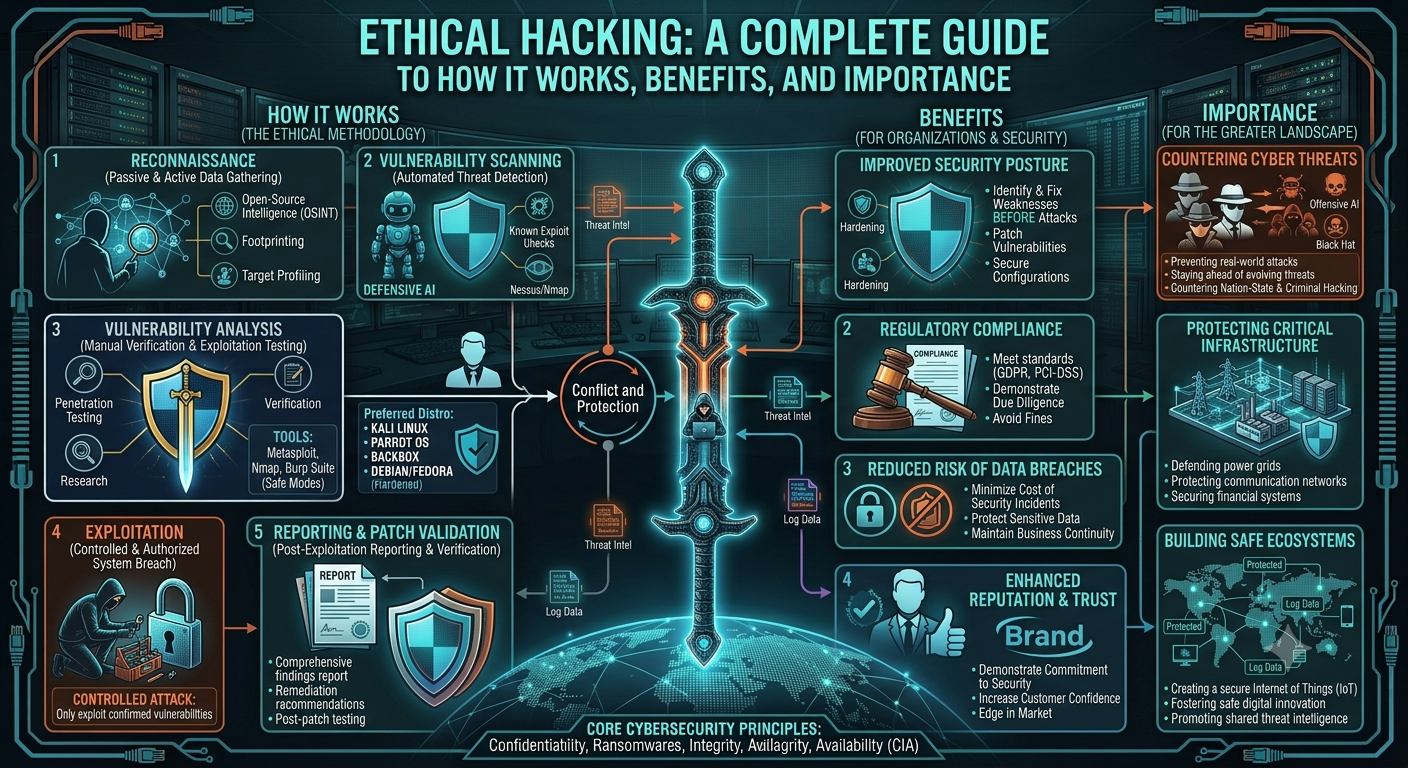
Ethical Hacking: A Complete Guide to How It Works, Benefits, and Importance
Introduction
The internet has become part of almost everything we do. People use online banking to manage their money, businesses store customer information in cloud systems, students attend classes through digital platforms, and government departments provide many services online.
This convenience has made life easier, but it has also created a growing security problem. Every website, application, server, and connected device can become a potential target for cybercriminals. A single security weakness may allow an attacker to steal information, disrupt services, or gain unauthorized access to an organization’s systems.
This is where ethical hacking becomes important.
Ethical hacking is a security practice in which authorized professionals test systems, networks, websites, and applications to discover weaknesses before criminals can exploit them. Instead of using vulnerabilities for personal gain, ethical hackers document their findings and help organizations fix the problems.
In simple terms, ethical hacking is about thinking like an attacker while working on the side of the defender.
What Is Ethical Hacking?
Ethical hacking is the authorized process of examining computer systems, networks, applications, or other digital environments for security vulnerabilities.
The most important word in this definition is authorized.
An ethical hacker must have permission from the system owner before performing security testing. Without authorization, the same activity could be considered illegal access.
The goal of ethical hacking is not to steal information or damage a system. The goal is to discover security weaknesses and provide useful information that allows an organization to improve its defenses.
For example, a company may hire an ethical hacker to test its website. During the assessment, the security professional may discover that an outdated software component contains a known vulnerability. The ethical hacker reports the issue, explains its potential impact, and recommends that the company update or replace the vulnerable component.
This process gives the organization an opportunity to fix the problem before a real attacker discovers it.
Who Is an Ethical Hacker?
An ethical hacker is a cybersecurity professional who is authorized to assess the security of a system.
Ethical hackers may work as:
- Penetration testers
- Security consultants
- Vulnerability analysts
- Red team professionals
- Application security specialists
- Network security professionals
- Security researchers
Their responsibilities can vary depending on the organization and the type of assessment being performed.
A good ethical hacker needs more than technical knowledge. Communication and professional judgment are equally important. A vulnerability report is only useful if the organization understands what was discovered, why it matters, and how it should be addressed.
Why Is Ethical Hacking Important?
Cyberattacks are not limited to large technology companies. Small businesses, schools, hospitals, financial institutions, government organizations, and online stores can all become targets.
Many attacks succeed because organizations do not know where their weaknesses are.
Ethical hacking provides a proactive approach to security. Instead of waiting for an attacker to discover a vulnerability, organizations can deliberately search for weaknesses under controlled and authorized conditions.
1. Finds Security Weaknesses
One of the main purposes of ethical hacking is identifying vulnerabilities.
These weaknesses may exist in:
- Websites
- Web applications
- Mobile applications
- Networks
- Servers
- Cloud environments
- Authentication systems
- APIs
- Security configurations
Finding these issues early gives security teams time to fix them.
2. Protects Sensitive Information
Organizations often handle valuable information such as customer records, financial information, employee data, business documents, and authentication credentials.
A successful cyberattack can expose this information and create serious consequences.
Security testing helps organizations identify weaknesses that could potentially expose sensitive data.
3. Reduces Financial Risk
Cybersecurity incidents can become expensive.
Businesses may face costs related to incident response, system recovery, legal obligations, customer notification, lost productivity, and reputational damage.
Ethical hacking does not eliminate these risks, but identifying vulnerabilities before an incident occurs can reduce the likelihood and potential impact of certain attacks.
4. Builds Customer Trust
Customers want to know that their information is being handled responsibly.
Organizations that take security seriously can strengthen their reputation and demonstrate that protecting customer information is an important part of their business practices.
How Does Ethical Hacking Work?
A professional ethical hacking engagement normally follows a structured process.
The exact methodology depends on the scope of the assessment, but several stages are common.
Step 1: Information Gathering
The first stage involves understanding the target environment.
The security professional may identify relevant systems, applications, domains, technologies, and publicly available information that falls within the agreed scope.
This stage helps create a picture of the environment before testing begins.
Information gathering is important because security professionals need to understand what they are testing and where potential exposure may exist.
Step 2: Finding Vulnerabilities
Once the environment is understood, the ethical hacker looks for possible weaknesses.
This can involve reviewing configurations, identifying outdated components, examining application behavior, and using authorized security testing tools.
The objective is to determine whether weaknesses exist and how serious they could be.
Step 3: Security Testing
The tester then validates relevant findings within the agreed rules of engagement.
This stage is carefully controlled. Ethical hackers should avoid unnecessary disruption, data loss, or damage to production systems.
The goal is to demonstrate the security impact of a vulnerability without causing harm.
Step 4: Reporting the Results
Reporting is one of the most important parts of an ethical hacking engagement.
A professional report normally explains:
- What was discovered
- Where the vulnerability exists
- How serious the issue is
- What systems may be affected
- Evidence supporting the finding
- Recommended remediation steps
A strong report gives technical teams enough information to fix the issue and allows management to understand the associated business risk.
Common Ethical Hacking Tools
Ethical hackers use a variety of tools depending on the type of security assessment.
Nmap
Nmap is widely used for network discovery and security auditing. It can help security professionals understand which hosts and services are available within an authorized environment.
Wireshark
Wireshark is a network protocol analyzer. It allows professionals to inspect network traffic and troubleshoot or investigate communication behavior.
Burp Suite
Burp Suite is commonly used for testing web applications. Security professionals can use it to inspect and analyze HTTP requests and responses during authorized application security assessments.
Metasploit
Metasploit is a security testing framework that can be used by professionals to validate certain vulnerabilities in controlled environments.
Kali Linux
Kali Linux is a Linux distribution designed for penetration testing, security research, digital forensics, and other cybersecurity activities. It includes many security tools in a convenient environment.
Tools are only part of the process, however. Having access to a security tool does not automatically make someone an ethical hacker. Understanding systems, networks, applications, vulnerabilities, and responsible testing practices is much more important.
Where Is Ethical Hacking Used?
Ethical hacking has applications across many industries.
Banking and Financial Services
Banks and financial institutions handle highly sensitive financial information. Security testing can help identify weaknesses in online banking systems, applications, networks, and authentication processes.
Government Organizations
Government departments manage large amounts of sensitive information and operate critical digital services. Security assessments can help identify weaknesses before they become major incidents.
Universities
Universities have complex environments containing student information, research data, employee records, and public-facing systems.
Ethical hacking can help educational institutions identify vulnerabilities across these environments.
Healthcare
Hospitals and healthcare organizations depend heavily on digital systems. Protecting patient information and maintaining system availability are important security priorities.
Software Companies
Software developers can use penetration testing and application security assessments to discover weaknesses before applications are released to customers.
Online Businesses
E-commerce companies process customer accounts, payments, orders, and personal information. Security testing can help identify weaknesses that could put these systems at risk.
Ethical Hacking vs. Malicious Hacking
The biggest difference between ethical hacking and malicious hacking is authorization and intent.
| Ethical Hacking | Malicious Hacking |
|---|---|
| Requires permission | Performed without authorization |
| Focuses on improving security | Often focuses on personal gain or damage |
| Findings are reported | Vulnerabilities may be exploited secretly |
| Operates within an agreed scope | Ignores legal boundaries |
| Aims to protect systems | Can compromise systems and data |
A technique itself does not determine whether an activity is ethical. Authorization, scope, intent, and responsible conduct matter.
Challenges of Ethical Hacking
Ethical hacking is valuable, but it is not without challenges.
Constantly Changing Threats
Cybersecurity changes quickly. New vulnerabilities, attack techniques, technologies, and defensive tools appear regularly.
Security professionals therefore need continuous education.
Complex IT Environments
Modern organizations may use on-premises servers, cloud services, mobile applications, APIs, remote employees, third-party providers, and connected devices.
Testing such environments requires careful planning.
Legal and Ethical Responsibilities
Security testing must always remain within the approved scope.
Testing systems without permission can lead to legal and professional consequences. Ethical hackers must understand authorization, rules of engagement, privacy requirements, and responsible disclosure.
Avoiding Business Disruption
Security assessments can potentially affect systems if they are performed carelessly.
Professional testers therefore need to plan their work carefully and understand which systems are sensitive or business-critical.
Skills Needed to Become an Ethical Hacker
People interested in ethical hacking should develop a strong foundation in cybersecurity rather than focusing only on individual tools.
Important areas include:
- Networking fundamentals
- Linux and Windows systems
- Web technologies
- Programming and scripting
- Databases
- Authentication and access control
- Vulnerability assessment
- Cybersecurity principles
- Security reporting
- Risk management
Curiosity is also valuable. Ethical hackers need to understand how systems work and constantly ask questions about where security weaknesses might exist.
How Organizations Can Benefit From Ethical Hacking
A good security assessment should not end when a report is delivered.
Organizations should prioritize the findings, fix vulnerabilities, verify the fixes, and continue monitoring their environment.
A useful cycle looks like this:
Discover → Assess → Fix → Verify → Monitor → Repeat
Security is an ongoing process. Even after vulnerabilities are fixed, new software updates, configuration changes, applications, and emerging threats can introduce new risks.
Conclusion
Ethical hacking has become an important part of modern cybersecurity because organizations cannot protect systems effectively if they do not understand their weaknesses.
Authorized security professionals help businesses identify vulnerabilities, evaluate potential risks, and improve their defenses before criminals have an opportunity to exploit those weaknesses.
From banks and hospitals to universities, government departments, software companies, and online businesses, ethical hacking can provide valuable insight into the security of digital environments.
However, ethical hacking is not simply about running security tools or finding vulnerabilities. It requires technical knowledge, careful planning, authorization, responsible behavior, and clear communication.
As technology continues to evolve, the need for skilled cybersecurity professionals will continue to grow. Ethical hackers will play an important role in helping organizations stay ahead of emerging threats and protect the systems and information that people depend on every day.
Frequently Asked Questions About Ethical Hacking
What is ethical hacking in simple words?
Ethical hacking is authorized security testing performed to find and help fix weaknesses in computer systems, networks, websites, or applications.
Is ethical hacking legal?
Ethical hacking can be legal when the tester has explicit permission and follows the agreed scope and rules of engagement. Testing systems without authorization can be illegal.
What tools do ethical hackers use?
Common tools include Nmap, Wireshark, Burp Suite, Metasploit, and Kali Linux. The appropriate tool depends on the type and scope of the security assessment.
Is ethical hacking a good cybersecurity career?
Yes. Ethical hacking is one area of cybersecurity, and there are career opportunities in penetration testing, vulnerability assessment, application security, red teaming, security consulting, and related fields.
What is the main goal of ethical hacking?
The primary goal is to identify security weaknesses before malicious attackers can exploit them and provide information that helps organizations improve their security.