
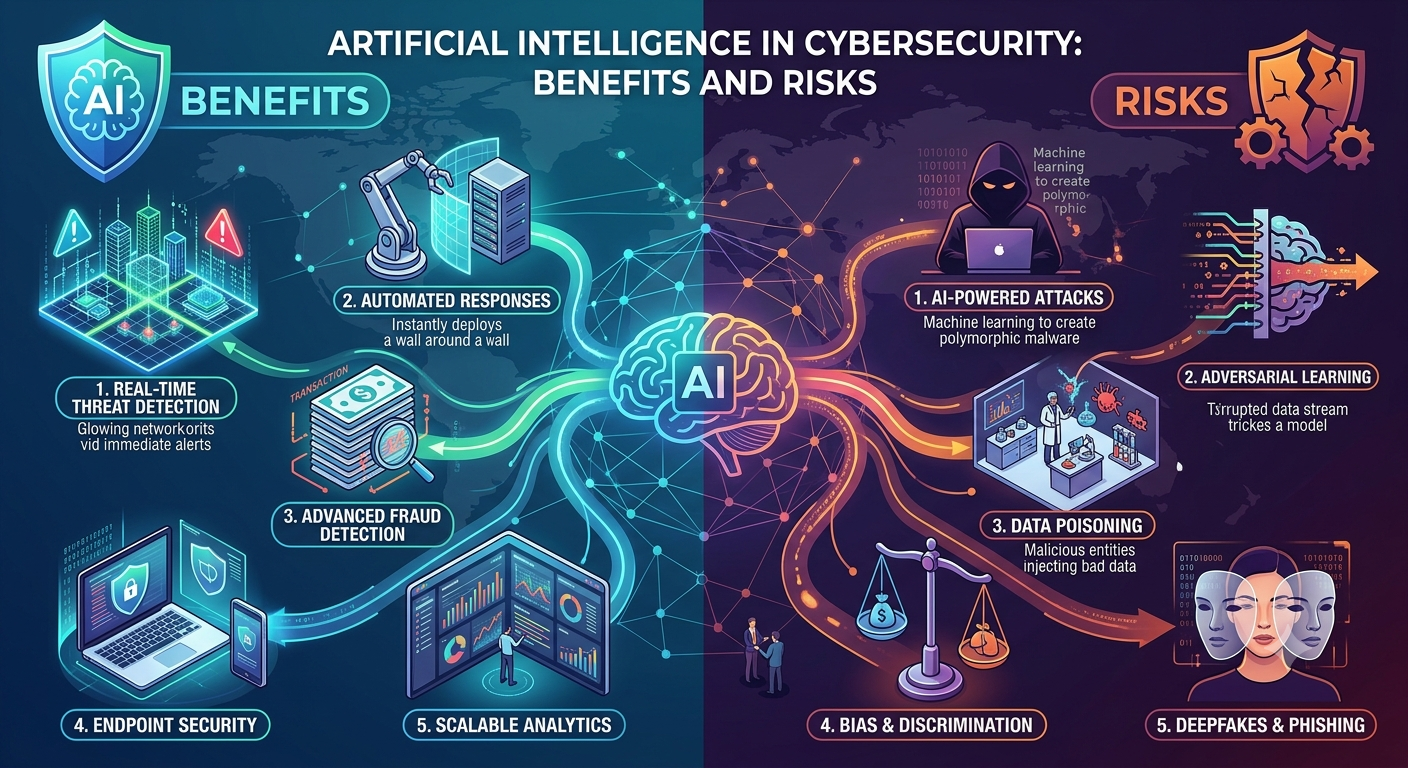
Artificial Intelligence in Cybersecurity: Benefits and Risks Explained
Artificial Intelligence in Cybersecurity: Benefits and Risks
The cybersecurity landscape has changed dramatically over the past decade. As cybercriminals adopt increasingly sophisticated techniques, traditional security tools alone are often not enough to detect and prevent attacks. Organizations now face a constant stream of threats, including ransomware, phishing campaigns, zero-day exploits, insider threats, and advanced persistent attacks.
To keep pace with these evolving risks, businesses are increasingly turning to Artificial Intelligence (AI). AI-powered cybersecurity solutions can analyze massive volumes of data, detect unusual behavior, identify threats in real time, and automate security tasks that once required significant human effort.
While AI offers tremendous advantages, it also introduces new challenges. Cybercriminals are beginning to use AI to create more convincing phishing emails, automate attacks, and discover vulnerabilities faster than ever before. Understanding both the benefits and the risks of AI in cybersecurity is essential for organizations seeking to build resilient security strategies.
In this guide, we’ll explore how Artificial Intelligence is transforming cybersecurity, the key advantages it provides, potential risks, real-world applications, and best practices for responsible implementation.
What Is Artificial Intelligence in Cybersecurity?
Artificial Intelligence in cybersecurity refers to the use of intelligent computer systems that can analyze data, recognize patterns, learn from experience, and make decisions to improve security operations.
Unlike traditional security software that relies mainly on predefined rules and signatures, AI systems can identify suspicious activities by recognizing abnormal behavior and adapting to new threats over time.
AI technologies commonly used in cybersecurity include:
- Machine Learning (ML)
- Deep Learning
- Natural Language Processing (NLP)
- Behavioral Analytics
- Predictive Analytics
- Neural Networks
These technologies enable organizations to detect threats more quickly, reduce false positives, and respond to incidents with greater efficiency.
Why AI Is Becoming Essential in Cybersecurity
Modern organizations generate enormous amounts of security data every day. Firewalls, endpoint protection platforms, cloud services, email systems, and network devices continuously produce logs and alerts.
Security teams often struggle to analyze this information manually.
Artificial Intelligence helps by:
- Processing millions of events in seconds
- Detecting suspicious behavior automatically
- Prioritizing high-risk alerts
- Reducing analyst workload
- Identifying previously unknown threats
As attack techniques become more advanced, AI provides organizations with the speed and scalability needed to defend increasingly complex environments.
Benefits of Artificial Intelligence in Cybersecurity
1. Faster Threat Detection
One of AI’s greatest strengths is its ability to detect threats much faster than traditional manual processes.
AI continuously monitors network traffic, user behavior, and system activity to identify unusual patterns that may indicate malicious activity.
Examples include:
- Suspicious login attempts
- Unexpected data transfers
- Privilege escalation
- Malware execution
- Insider threats
Early detection helps organizations respond before attackers cause significant damage.
2. Real-Time Monitoring
Cyberattacks can occur at any time, making continuous monitoring essential.
AI-powered security platforms provide:
- 24/7 monitoring
- Instant anomaly detection
- Automated alert generation
- Continuous risk assessment
This constant vigilance improves an organization’s ability to detect attacks as they happen.
3. Improved Malware Detection
Traditional antivirus software primarily relies on known malware signatures.
AI-based solutions can identify previously unseen malware by analyzing behavioral characteristics rather than depending solely on signature databases.
This helps detect:
- Zero-day malware
- Fileless malware
- Polymorphic malware
- Ransomware variants
As attackers constantly modify malware to evade detection, AI offers greater adaptability.
4. Automated Incident Response
Security teams often spend valuable time performing repetitive tasks.
AI can automate many of these activities, including:
- Isolating infected devices
- Blocking malicious IP addresses
- Disabling compromised accounts
- Prioritizing alerts
- Collecting forensic data
Automation enables security professionals to focus on complex investigations while reducing response times.
5. Better Phishing Detection
Phishing remains one of the most successful cyberattack methods.
AI improves email security by analyzing:
- Email content
- Sender reputation
- Writing style
- Embedded links
- Attachments
- Behavioral indicators
Advanced AI systems can identify phishing attempts that may bypass traditional spam filters.
6. Behavioral Analysis
Every employee has unique patterns of activity.
Artificial Intelligence establishes a baseline of normal behavior and identifies unusual actions, such as:
- Accessing systems outside normal working hours
- Downloading unusually large amounts of data
- Logging in from unfamiliar locations
- Using unauthorized devices
Behavioral analytics help detect insider threats and compromised accounts.
7. Reduced False Positives
Security analysts often receive thousands of alerts every day, many of which are harmless.
AI helps prioritize alerts by identifying those most likely to represent genuine threats.
Benefits include:
- Less alert fatigue
- Faster investigations
- Better resource allocation
- Improved operational efficiency
Reducing unnecessary alerts allows security teams to focus on the incidents that matter most.
8. Predictive Threat Intelligence
AI can analyze historical attack data, threat intelligence feeds, and emerging trends to predict future risks.
This allows organizations to:
- Identify vulnerable systems
- Anticipate attack patterns
- Strengthen defenses proactively
- Prioritize security investments
Predictive analytics helps shift cybersecurity from a reactive approach to a proactive one.
Real-World Applications of AI in Cybersecurity
Artificial Intelligence is already being used across a wide range of cybersecurity functions.
Network Security
AI continuously analyzes network traffic to detect anomalies, unauthorized access attempts, and suspicious communication patterns.
Endpoint Protection
Modern endpoint security solutions use AI to identify malicious processes, ransomware activity, and unusual system behavior on laptops, desktops, and mobile devices.
Cloud Security
As businesses migrate to cloud environments, AI helps monitor cloud workloads, detect configuration errors, and identify unauthorized access attempts.
Fraud Detection
Banks, payment providers, and e-commerce platforms use AI to identify fraudulent transactions by analyzing spending patterns, device information, and user behavior in real time.
Identity and Access Management (IAM)
AI enhances identity security by evaluating login behavior, device reputation, geographic location, and authentication patterns before granting access.
This adaptive approach strengthens access controls without unnecessarily disrupting legitimate users.
Risks of Artificial Intelligence in Cybersecurity
While Artificial Intelligence offers significant advantages, it also introduces new security challenges. Organizations should understand these risks before relying heavily on AI-driven security solutions.
1. AI-Powered Cyberattacks
Cybercriminals are increasingly using AI to automate attacks, identify vulnerabilities, and evade traditional security controls.
Examples include:
- Automated password guessing
- Intelligent vulnerability scanning
- AI-assisted malware
- Adaptive ransomware
- Automated reconnaissance
As AI technology becomes more accessible, attackers can launch faster and more sophisticated campaigns.
2. Advanced Phishing Attacks
AI enables attackers to create highly convincing phishing emails with fewer grammatical errors and more personalized content.
Criminals can use AI to:
- Generate realistic emails
- Mimic writing styles
- Create fake customer support messages
- Personalize scams using publicly available information
These attacks are often more difficult for users to identify.
3. Deepfake Technology
AI-generated audio and video can impersonate executives, employees, or trusted partners.
Examples include:
- Fake CEO voice calls requesting urgent payments
- Fraudulent video meetings
- Identity impersonation
- Social engineering campaigns
Businesses should verify unusual requests through trusted communication channels.
4. Adversarial AI Attacks
Attackers may intentionally manipulate AI models by providing misleading or malicious input.
This can cause AI systems to:
- Misclassify malware as safe
- Ignore malicious traffic
- Produce inaccurate security decisions
Protecting AI models from manipulation is becoming an important area of cybersecurity research.
5. Privacy Concerns
AI systems often require access to large amounts of data for training and analysis.
Without proper governance, organizations may expose:
- Customer information
- Employee records
- Financial data
- Business communications
Strong data protection policies and access controls are essential when deploying AI solutions.
Real-World Applications of AI in Cybersecurity
Artificial Intelligence is already integrated into many modern security products and services.
Endpoint Detection and Response (EDR)
AI monitors endpoints for suspicious behavior and can automatically isolate compromised devices to limit the spread of an attack.
Security Information and Event Management (SIEM)
AI helps SIEM platforms correlate events, prioritize alerts, and identify hidden attack patterns across multiple systems.
Identity and Access Management (IAM)
AI analyzes login behavior to detect anomalies, such as impossible travel, unusual devices, or unexpected access times.
Fraud Detection
Banks and financial institutions use AI to detect suspicious transactions in real time by analyzing user behavior and transaction history.
Cloud Security
AI continuously monitors cloud environments for misconfigurations, unusual activity, and unauthorized access attempts.
Best Practices for Using AI in Cybersecurity
To maximize the benefits of AI while reducing risks, organizations should adopt a balanced approach.
Combine AI with Human Expertise
AI should support—not replace—security professionals. Human analysts are still essential for investigating complex incidents, making strategic decisions, and validating AI findings.
Keep AI Models Updated
Threats evolve rapidly. Regularly update AI models with fresh threat intelligence and security data to maintain detection accuracy.
Protect Training Data
Ensure that datasets used to train AI systems are accurate, trustworthy, and protected from unauthorized modification.
Monitor AI Performance
Evaluate AI systems regularly for:
- Detection accuracy
- False positives
- False negatives
- Bias in decision-making
- Overall effectiveness
Continuous monitoring helps identify areas for improvement.
Implement Strong Access Controls
Restrict access to AI platforms, training data, and administrative functions to authorized personnel only.
Follow Ethical AI Practices
Develop policies that promote transparency, accountability, and responsible use of AI. Consider privacy regulations and ensure AI systems respect user rights.
The Future of Artificial Intelligence in Cybersecurity
AI is expected to play an even greater role in cybersecurity as technology continues to evolve.
Emerging trends include:
- Autonomous threat detection
- AI-assisted security operations centers (SOCs)
- Predictive cyber risk analysis
- Intelligent threat hunting
- Self-healing systems
- AI-driven vulnerability management
- Integration with Zero Trust security architectures
At the same time, organizations must prepare for increasingly sophisticated AI-enabled attacks, making continuous investment in cybersecurity skills and technology essential.
Challenges of Adopting AI in Cybersecurity
Despite its advantages, implementing AI is not without challenges.
Common obstacles include:
- High implementation costs
- Shortage of skilled cybersecurity professionals
- Integration with legacy systems
- Data quality issues
- Ethical and legal considerations
- Managing false positives and false negatives
Organizations should evaluate their security needs, available resources, and long-term goals before deploying AI-based solutions.
Frequently Asked Questions (FAQs)
Can Artificial Intelligence replace cybersecurity professionals?
No. AI is a powerful tool that automates repetitive tasks and improves threat detection, but it cannot replace human judgment, experience, or strategic decision-making.
Is AI effective against ransomware?
Yes. AI can detect suspicious behaviors commonly associated with ransomware, such as rapid file encryption, unusual process activity, and unauthorized changes to system files. However, it should be part of a broader security strategy.
How does AI improve phishing protection?
AI analyzes email content, sender behavior, links, attachments, and communication patterns to identify phishing attempts that may bypass traditional filters.
What industries benefit most from AI in cybersecurity?
Industries such as finance, healthcare, government, retail, manufacturing, education, and technology all benefit from AI-powered security due to the large volumes of sensitive data they manage.
What is the biggest limitation of AI in cybersecurity?
AI depends on quality data and proper configuration. Poor training data, evolving attack techniques, and adversarial manipulation can reduce its effectiveness if not carefully managed.
Conclusion
Artificial Intelligence has become one of the most influential technologies shaping the future of cybersecurity. Its ability to analyze massive amounts of data, detect unusual behavior, automate routine tasks, and respond to threats in real time makes it an invaluable asset for modern organizations. From identifying sophisticated malware to improving phishing detection and accelerating incident response, AI helps security teams stay ahead of an increasingly complex threat landscape.
However, AI is not a standalone solution. Cybercriminals are also using AI to create more convincing phishing campaigns, automate attacks, and exploit vulnerabilities in new ways. Organizations must recognize that AI introduces both opportunities and risks.
The most effective cybersecurity strategies combine AI-powered tools with skilled security professionals, strong governance, employee awareness training, and continuous monitoring. By adopting AI responsibly and integrating it into a comprehensive defense strategy, businesses can improve resilience, reduce cyber risks, and better protect their critical systems and sensitive information.