

Why Cybersecurity Matters More Than Ever in 2026
| Why Cybersecurity Matters More Than Ever in 2026 |
| A Data-Driven Report |
Table of Content:
2-The Economics of Cybercrime Have Reached a Tipping Point: 2
3-Ransomware Is Faster, More Frequent, and More Costly: 3
4-Attackers Have Moved Beyond Malware: 4
5-Artificial Intelligence Is Reshaping Both Sides of the Fight: 5
6-Detection Is Still Too Slow: 6
7-Defenders Are Responding – But the Gap Persists: 7
8-Small Businesses Remain Disproportionately Exposed: 8
Introduction:
Cybersecurity is no longer a background IT concern; it is a determining factor in whether businesses stay solvent, hospitals keep operating, and everyday consumers can trust the digital systems they rely on. By 2026, the scale of cybercrime has grown so large that it now behaves less like a technical nuisance and more like a structural feature of the global economy. This report draws on recent industry data, from CrowdStrike, Statista, Cybersecurity Ventures, IBM, and multiple 2026 industry statistics roundups, to explain why cybersecurity matters more in 2026 than at any previous point, and what specifically has changed to make the stakes so much higher.
The Economics of Cybercrime Have Reached a Tipping Point:
The clearest evidence that cybersecurity has become an economic issue, not just a technical one, is the sheer cost of cybercrime. Global cybercrime losses reached an estimated $10.5 trillion in 2025 and are projected to climb toward $15.63 trillion by 2029, according to Statista-sourced industry figures. If cybercrime were measured as a national economy, these figures would already place it among the largest in the world, ahead of the GDP of most countries. This growth is not gradual background noise; it reflects a compounding trend as more of the global economy, commerce, healthcare, infrastructure, and personal life, moves online and becomes a viable target.
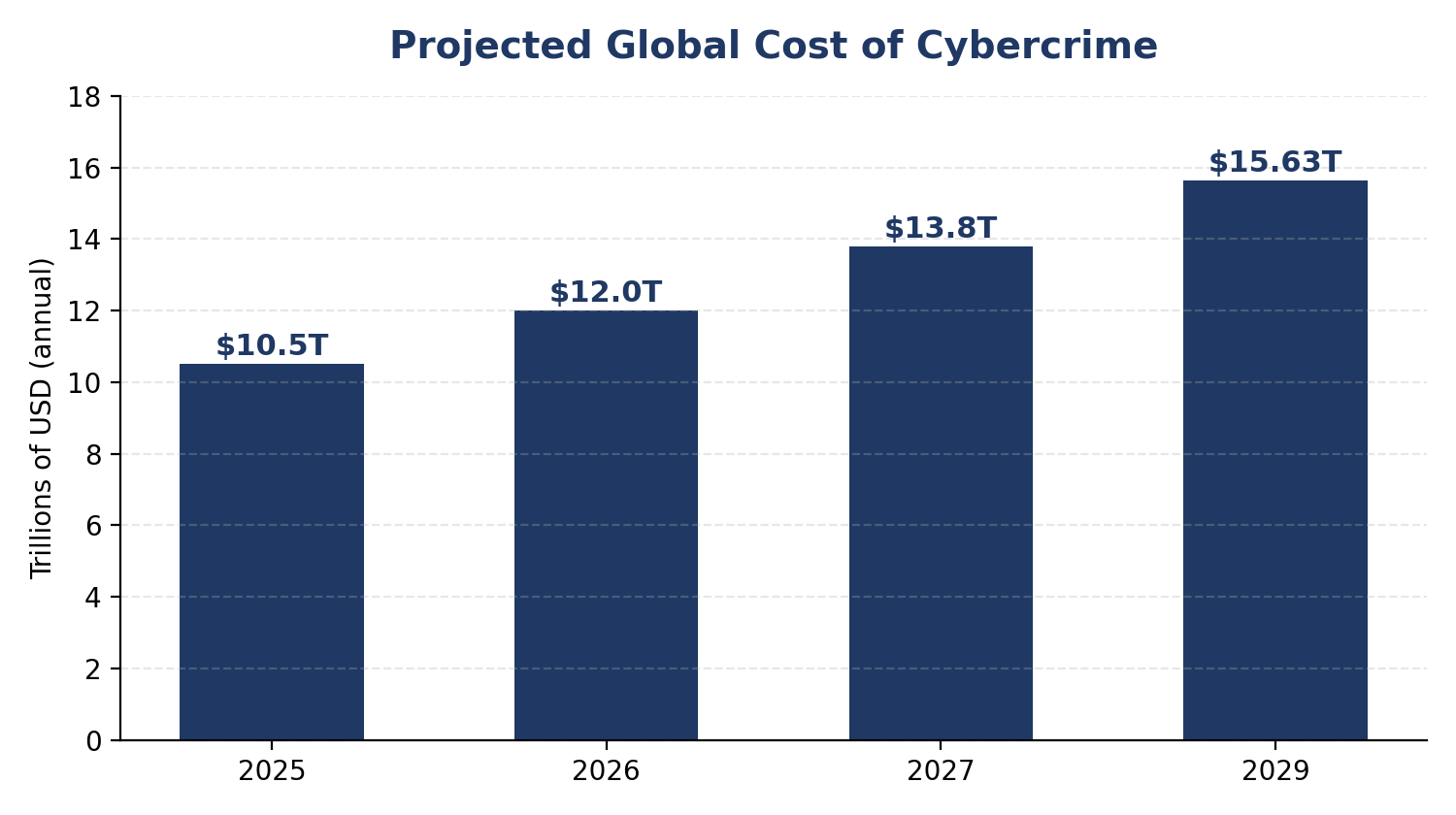
Figure 1: Projected global cost of cybercrime, 2025–2029 (source: Statista, via CDNetworks 2026 report)
In direct response, global information security spending is projected to reach $183.9 billion in 2026, a 15 percent year-over-year increase. That spending increase is itself a signal: organizations are no longer treating security as a fixed-percentage line item but as a rapidly scaling cost center, because the alternative, absorbing breach costs and reputational damage, has become more expensive than prevention.
Ransomware Is Faster, More Frequent, and More Costly:
Ransomware remains the single most disruptive category of cyberattack, and its pace is accelerating sharply. In 2021, a ransomware attack struck a business or consumer somewhere in the world roughly every 11 seconds. Cybersecurity Ventures projects that by 2031 this will compress to every 2 seconds, equivalent to over 43,000 attacks per day. Annual global damage from multi-stage ransomware extortion, attacks that combine encryption with data theft and public leak threats, is forecast to reach $74 billion in 2026 alone.
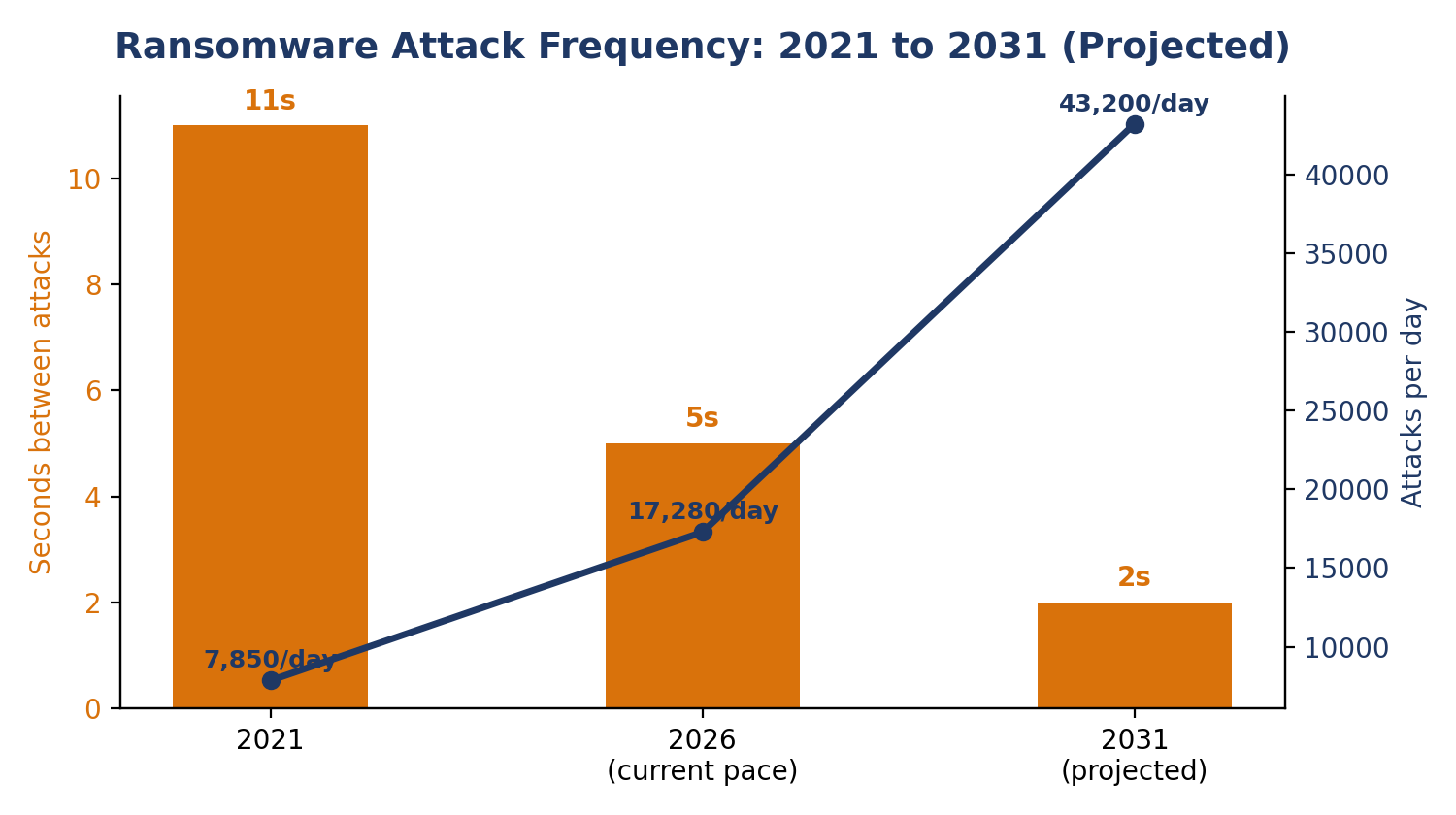
Figure 2: Ransomware attack frequency is compressing from once every 11 seconds (2021) toward once every 2 seconds (2031 projected).
The nature of ransomware has also shifted. Roughly half of current attacks now go beyond simple file encryption, combining data theft and extortion specifically to defeat organizations that believe backups alone are sufficient protection. Healthcare has emerged as the costliest target, with breaches in that sector averaging an estimated $12.6 million per incident, far above the global cross-industry average, reflecting both the sensitivity of medical data and the operational danger of disrupting patient care systems.
Attackers Have Moved Beyond Malware:
One of the most consequential shifts heading into 2026 is that most attacks no longer rely on malicious software at all. CrowdStrike’s 2026 Cyber Threats Report found that 82 percent of detected intrusions were malware-free, meaning they relied instead on phishing, social engineering, stolen credentials, and abuse of legitimate trusted access. This proportion has risen steadily and sharply: from 40 percent in 2019, to 62 percent in 2021, to 75 percent in 2023, to 82 percent by 2026.
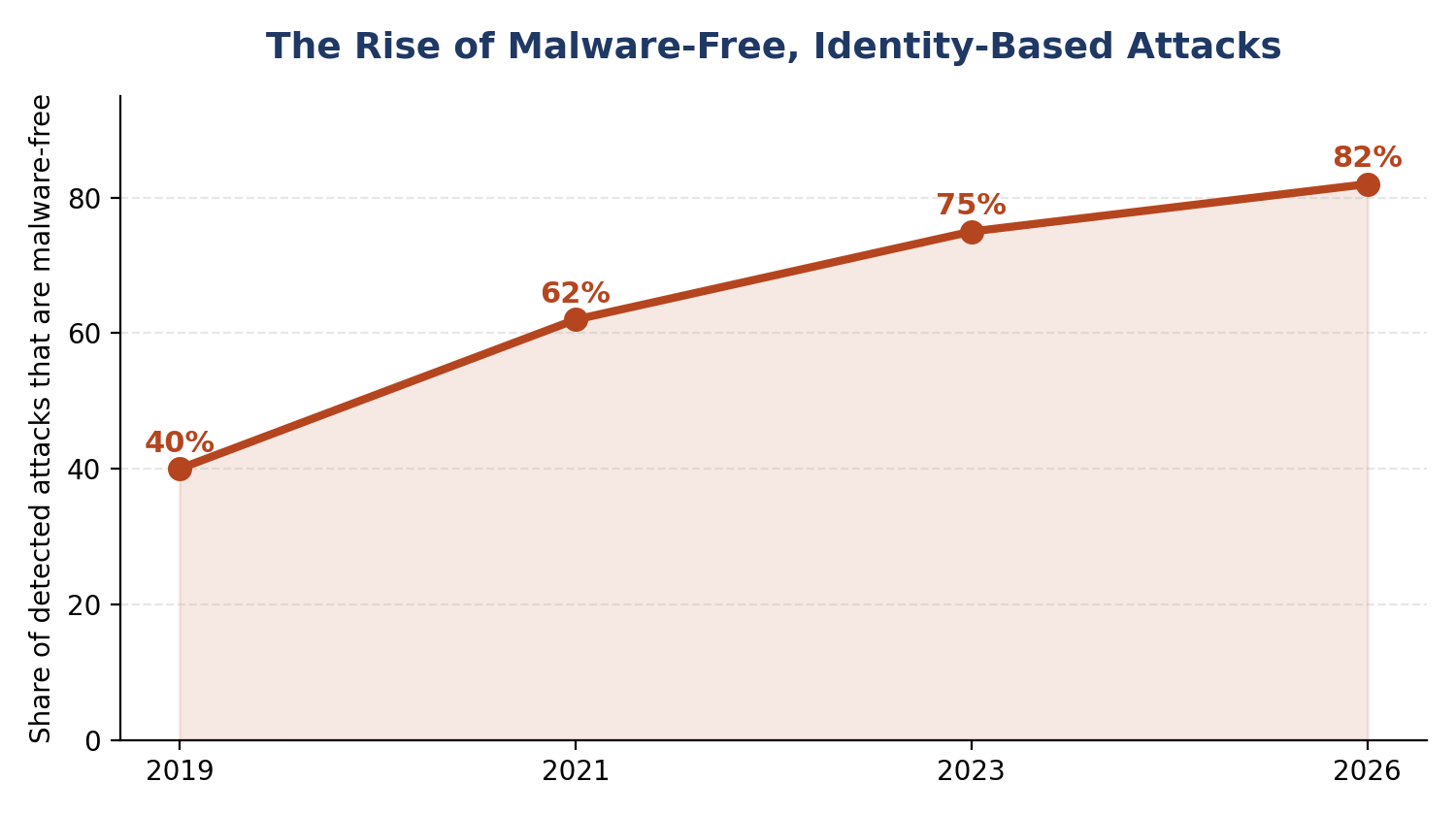
Figure 3: The share of detected attacks that are malware-free has more than doubled since 2019 (source: CrowdStrike Global Threat Report, via NU and PreVeil 2026 statistics).
This trend matters because it exposes the limits of traditional, signature-based antivirus and malware-scanning defenses. If an attacker never installs malicious code and instead logs in using a stolen or phished credential, most legacy security tools have nothing to detect. It is a core reason the industry has shifted its emphasis toward identity governance, multi-factor authentication, and zero trust architectures, treating every access request as unverified by default rather than trusting anything already inside the network perimeter.
Artificial Intelligence Is Reshaping Both Sides of the Fight:
AI has become a genuine double-edged sword in cybersecurity by 2026. On the offensive side, the FBI’s Internet Crime Complaint Center recorded more than 22,000 AI-related complaints in 2025 alone, with adjusted losses exceeding $893 million, covering AI-generated phishing content, deepfake-based fraud, and automated vulnerability discovery. Concern about this shift is widespread: 87 percent of surveyed organizations now identify AI-related vulnerabilities as their fastest-growing category of cyber risk, and the share of people actively assessing the security of AI tools they use nearly doubled in a single year, from 37 percent in 2025 to 64 percent in 2026.
On the defensive side, AI-powered security tools are scaling just as quickly: the global AI cybersecurity market is projected to exceed $133 billion by 2030, and organizations that adopt AI-driven detection and automated response report average breach-cost savings of roughly $2.2 million annually, through faster detection, faster containment, and reduced need for manual security operations work. The net effect is that AI is simultaneously making attacks cheaper and faster to launch and making sophisticated defense more accessible, an arms race playing out inside nearly every organization’s security stack simultaneously.
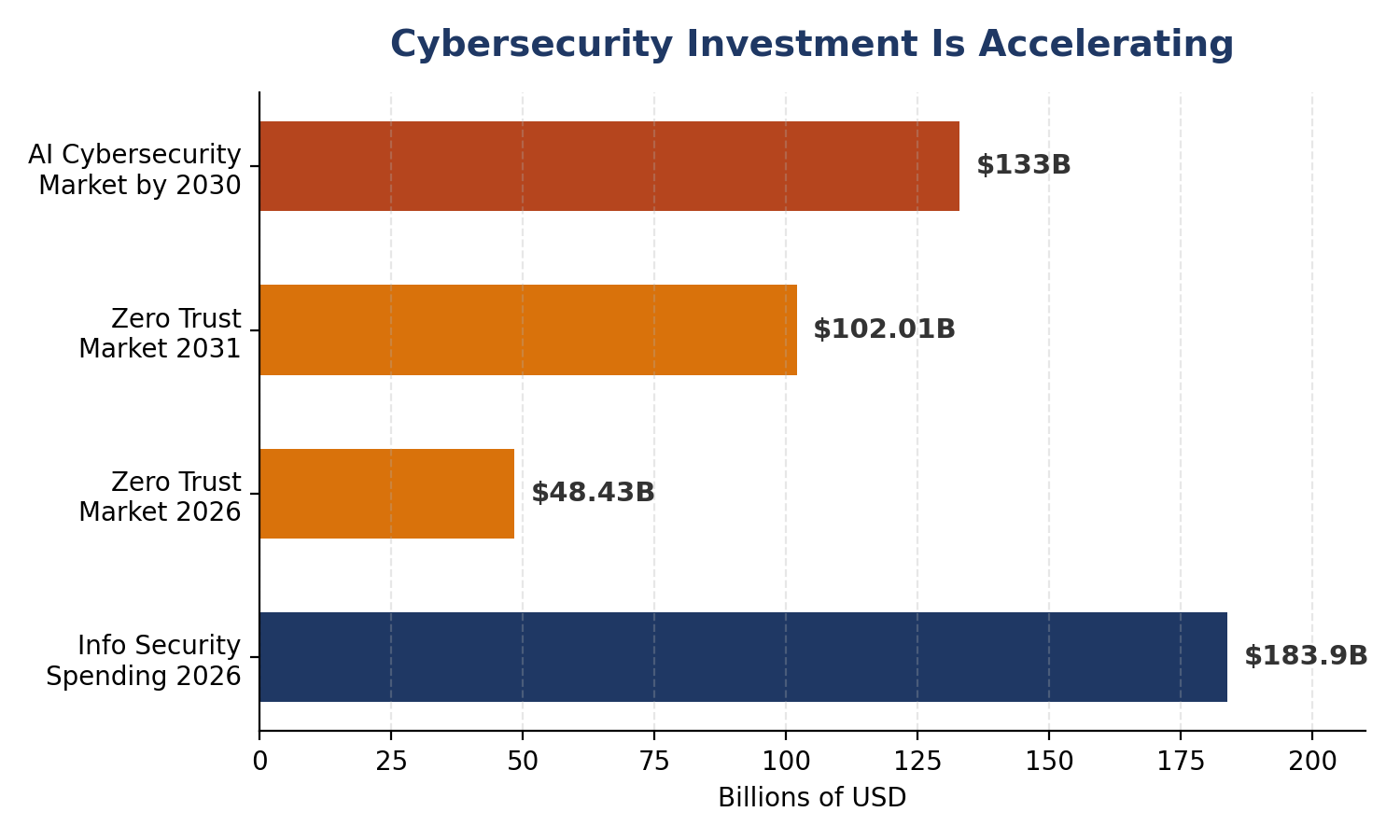
Figure 4: Global security spending, the zero trust market, and the AI cybersecurity market are all expanding rapidly (source: ORDR 2026 Threat Data Report).
Detection Is Still Too Slow:
Despite rising investment, the gap between attack and detection remains dangerously wide. Organizations require an average of 277 days to identify and contain a security incident, nearly nine months during which attackers can move laterally, exfiltrate data, or prepare a ransomware payload undetected. Combined with an average global breach cost of $4.88 million, and far higher in sectors like healthcare, this detection gap is one of the clearest arguments that cybersecurity spending must prioritize faster detection and response capability, not just perimeter prevention.
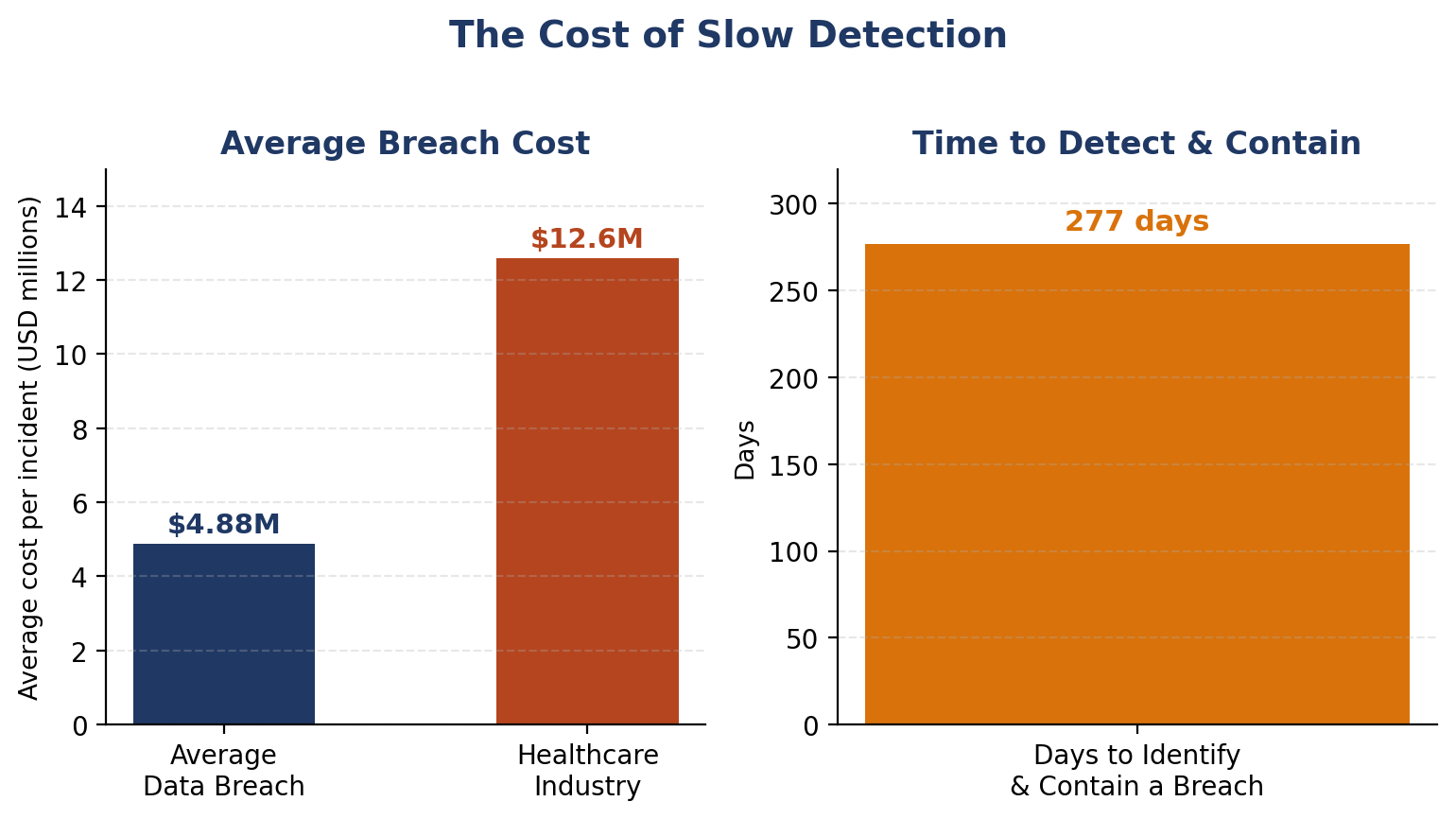
Figure 5: Average breach cost by sector and the average time organizations take to identify and contain a breach (source: ORDR 2026 Threat Data Report).
Defenders Are Responding – But the Gap Persists:
The security industry’s response to these pressures is visible in where investment is flowing. The zero trust security market, built on the principle that no request for access is trusted by default regardless of its origin inside or outside the network, is valued at $48.43 billion in 2026 and is projected to more than double to $102.01 billion by 2031. Security automation and AI-assisted operations are being adopted specifically to compress detection and response time, since the data shows this is where the largest cost savings are realized.
Even so, most organizations report they remain underprepared. Only a small minority feel their current cybersecurity staffing and posture is adequate, and 53 percent of leaders say they feel unprepared specifically for the cybersecurity risks introduced by AI adoption. This gap between rising investment and persistent underpreparedness is itself part of why 2026 is being described across the industry as a pivotal year: organizations are spending more than ever, yet confidence in their own defenses has not kept pace with the threat.
Small Businesses Remain Disproportionately Exposed:
Large enterprises dominate headlines, but small and mid-sized businesses face the sharpest relative risk. Seventy percent of cyberattackers deliberately target small businesses, which are three times more likely to be targeted than larger companies, and 61 percent of small businesses experienced at least one breach in the past year. Seventy percent of ransomware attacks in recent years have hit organizations with fewer than 500 employees. Vishing (voice phishing) operations grew 442 percent between the first and second half of 2024 alone, a tactic that disproportionately affects smaller organizations without dedicated security operations teams to catch it.
This matters because small businesses often assume they are too insignificant to be targeted, when the data shows the opposite: their comparatively weaker defenses make them more attractive, not less, to opportunistic attackers running automated campaigns at scale.
Conclusion:
Taken together, the 2026 data tells a consistent story. Cybercrime has grown into a multi-trillion-dollar drag on the global economy; ransomware is accelerating toward attacks every two seconds; the majority of intrusions no longer use malware at all, undermining older defensive assumptions; AI is lowering the cost of attack while simultaneously enabling faster defense; detection still takes the better part of a year on average; and small businesses, despite assuming otherwise, are disproportionately in the crosshairs. Cybersecurity matters more in 2026 not because any single threat is new, but because these trends are compounding simultaneously, scale, speed, cost, and sophistication all rising together, at a moment when nearly every organization, regardless of size or sector, now depends on digital systems to function at all.
References:
101 Cybersecurity Statistics and Trends for 2026 – National University. https://www.nu.edu/blog/cybersecurity-statistics/
Key Cybersecurity Statistics and Emerging Trends for 2026 – CDNetworks. https://www.cdnetworks.com/blog/cloud-security/cybersecurity-statistics-and-trends-2026/
2026 Cybersecurity Statistics & Threat Data Report – ORDR. https://ordr.net/blog/cybersecurity-statistics-2026-report
The Top Cybersecurity Stats to Know in 2026 – PreVeil. https://www.preveil.com/blog/cybersecurity-statistics/
Key Cyber Security Statistics for 2026 – SentinelOne. https://www.sentinelone.com/cybersecurity-101/cybersecurity/cyber-security-statistics/
10 Cyber Security Trends For 2026 – SentinelOne. https://www.sentinelone.com/cybersecurity-101/cybersecurity/cyber-security-trends/
47 Cybersecurity Statistics and Facts [2026] – University of San Diego. https://onlinedegrees.sandiego.edu/cyber-security-statistics/
225 Cybersecurity Stats and Facts for 2026 – VikingCloud. https://www.vikingcloud.com/blog/cybersecurity-statistics