
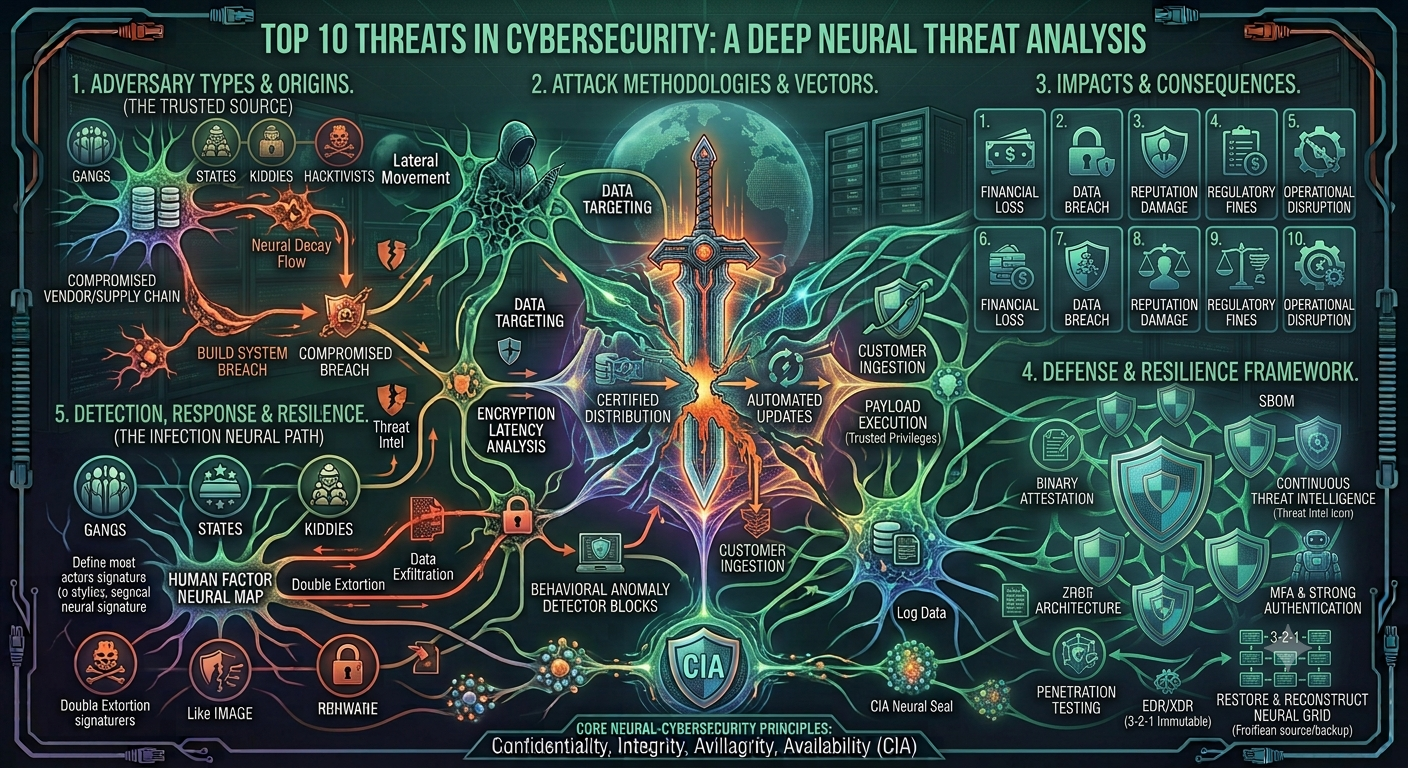
Top 10 threats in Cybersecurity
The top cybersecurity threats in 2026 are dominated by agentic AI-driven attacks, advanced identity and credential abuse, and multi-stage ransomware extortion.
top cybersecurity threats in 2026
Emerging Risks and Defense Strategies
Table of contents
2- The 2026 Cyber threat reality: Key statistics: 2
3- The top 10 cybersecurity threats of 2026: 3
Threat 1: AI-Assisted Autonomous Attacks: 3
Threat 2: AI-Enhanced Phishing and Social Engineering: 3
Threat 3: Identity Abuse and Credential Compromise: 4
Threat 4: Ransomware 3.0 and Intelligent Extortion: 4
Threat 5: Supply Chain Attacks: 5
Threat 6: DDoS Megascale Operations: 5
Threat 7: Deepfake and Synthetic Identity Fraud: 6
Threat 8: IoT and Edge Device Vulnerabilities: 6
Threat 9: Adversarial AI and Data Poisoning: 7
Threat 10: Post-Quantum Cryptographic Pressure: 7
4- Summary Comparison of All 10 Threats: 8
5- Why These Threats Matter for Cybersecurity Professionals: 9
6- Critical Analysis of the Article: 9
INTRODUCTION:
The cybersecurity landscape of 2026 is defined by an unprecedented arms race between attackers and defenders. As organizations accelerate their digital transformation, adversaries are harnessing emerging technologies particularly artificial intelligence to launch attacks at a speed and scale that was previously unimaginable. Every defensive tactic is met by a novel offensive breakthrough, making cybersecurity one of the most critical and fast-evolving disciplines in the world today.
This report is based on top cybersecurity threats in 2026: emerging and how to defend against them. This report identifies the ten most consequential cybersecurity threats of 2026, supported by real-world statistics and actionable defense strategies.
The 2026 Cyber threat reality: Key statistics:
Before examining individual threats, it is important to understand the broader statistical context of the 2026 cybersecurity environment. The EC-Council article presents five critical figures that frame the scale of the problem:
| Statistic | Key findings |
| AI-Driven Attack Growth | 87% of organizations rank AI vulnerabilities as the fastest-growing cyber risk |
| Global Cyber Incidents (2025) | Over 7.5 million incidents recorded — a significant rise from the prior year |
| Ransomware Dominance | Ransomware drove more than half of all global cyberattacks |
| Phishing as Entry Point | 91% of all successful breaches began with a phishing attack |
| Vulnerabilities Volume | CVE database exceeds 305,000 entries; 30,000+ new disclosures projected in 2026 |
These statistics paint a clear picture: cyber threats are not just growing in number but are becoming more automated, intelligent, and financially devastating. The global cost of cybercrime is projected to rise from $9.22 trillion in 2024 to $13.82 trillion by 2028 making it one of the most expensive challenges facing society today.
The top 10 cybersecurity threats of 2026:
This report identifies ten distinct threat categories that are reshaping the cybersecurity landscape in 2026. Each is analyzed below with its description, real-world context, target victims, and recommended defenses.
Threat 1: AI-Assisted Autonomous Attacks:
Artificial intelligence has fundamentally transformed the nature of cyberattacks. In 2026, attackers are deploying AI agents capable of performing autonomous discovery, exploitation, and lateral movement across networks drastically reducing the time between initial breach and full compromise.
Unlike traditional malware that follows fixed instructions, AI-powered attack tools can adapt in real-time, identify vulnerabilities they were not specifically programmed to find, and evade signature-based detection systems. A notable example cited in the article involves AI malware that autonomously uncovered and weaponized OpenSSL vulnerabilities using AI-powered scanning tools.
Primary targets:
- Large enterprises with legacy systems.
- Cloud environments with extensive API surfaces.
- Organizations with delayed patch management cycles.
Defense strategies:
- Deploy defender-side AI platforms for behavioral threat detection.
- Implement automated privilege escalation constraints.
- Use continuous monitoring to detect anomalous network behavior.
Threat 2: AI-Enhanced Phishing and Social Engineering:
Phishing remains the single most prevalent entry point for cyberattacks responsible for 91% of all successful breaches according to the article. In 2026, generative AI has made phishing dramatically more effective by enabling attackers to craft highly personalized, grammatically perfect, and contextually convincing messages at scale.
Traditional phishing was easy to spot due to poor grammar, generic salutations, and suspicious links. AI-generated phishing now mimics the writing style of colleagues, references real recent events, and is nearly indistinguishable from legitimate communications. Credential theft increased by 160% in 2025, driven largely by these AI-enhanced campaigns.
- Organizations without phishing-resistant MFA are especially vulnerable.
- Employees without regular security awareness training are prime targets.
- Enforce phishing-resistant MFA (e.g., hardware security keys).
- Conduct regular red-team phishing simulations.
- Invest in adaptive security awareness training programs.
Threat 3: Identity Abuse and Credential Compromise:
Identity-based attacks have become as common as malware. In 2026, compromised credentials usernames, passwords, tokens, and session cookies are the primary mechanism attackers use to gain unauthorized access to systems. The article notes that 75% of all intrusions now involve compromised identity credentials.
This shift reflects a broader trend: rather than exploiting technical vulnerabilities, attackers are simply “logging in” using stolen credentials obtained through phishing, data breaches, or dark web markets. Federated identity systems, cloud service accounts, and unmanaged third-party vendor accounts are particularly at risk.
- Implement Zero Trust architecture never trust, always verify.
- Enforce continuous authentication and behavioral analytics.
- Apply strict identity governance and privileged access management (PAM).
- Monitor for credential exposure on dark web threat intelligence feeds.
Threat 4: Ransomware 3.0 and Intelligent Extortion:
Ransomware has evolved far beyond simple file encryption. In 2026, “Ransomware 3.0” combines data encryption with data theft, deepfake blackmail, and targeted individual coercion creating multi-layered extortion schemes that are far harder for organizations to simply recover from by restoring backups.
Ransomware now drives over half of all global cyberattacks, with healthcare, manufacturing, and critical infrastructure being the most heavily targeted sectors. Victims face not just operational disruption but also reputational damage, regulatory penalties, and personal threats to executives.
- Healthcare – patient data is extremely valuable on black markets.
- Manufacturing -operational disruption has immediate financial consequences.
- Critical infrastructure – power grids, water systems, transport networks.
Defense strategies:
- Maintain immutable, air-gapped backups tested regularly.
- Conduct ransomware incident simulation exercises.
- Implement network segmentation to limit lateral movement.
Threat 5: Supply Chain Attacks:
Supply chain attacks exploit the trust organizations place in their software vendors and third-party providers. Rather than attacking a target directly, adversaries compromise a trusted supplier then use that foothold to infiltrate all downstream customers simultaneously, multiplying the impact of a single breach.
A striking real-world example cited in the article is the Notepad++ supply chain compromise, in which a widely-used open-source text editor was targeted to deliver malicious code to its user base. Supply chain attacks are particularly dangerous because they bypass traditional perimeter defenses entirely.
- Conduct thorough vendor security assessments before onboarding.
- Implement Software Bills of Materials (SBOMs) for transparency.
- Use code integrity verification and runtime attestation.
- Monitor third-party software for unexpected behavioral changes.
Threat 6: DDoS Megascale Operations:
Distributed Denial of Service (DDoS) attacks have reached a new scale in 2026. Massive botnets networks of compromised devices are now capable of launching attacks exceeding terabits per second, capable of overwhelming even the most well-resourced targets. The article highlights a specific example: the Aisuru botnet launched a 31.4 Terabits-per-second DDoS attack, the largest ever recorded, which was ultimately mitigated by Cloudflare.
- Deploy distributed traffic scrubbing infrastructure.
- Implement real-time anomaly detection at network edges.
- Use cloud-based DDoS mitigation services with auto-scaling capacity.
Threat 7: Deepfake and Synthetic Identity Fraud:
Generative AI has made it trivially easy to create convincing fake audio, video, and text impersonating real people. In 2026, cybercriminals are using deepfake technology to impersonate executives, authorize fraudulent financial transactions, and manipulate employees into bypassing security controls. A voice clone of a CEO, for example, can be used to instruct a finance employee to transfer funds to an attacker-controlled account.
- Enterprises without multi-factor verification tied to user behavior.
- Organizations relying on voice or video calls for authorization.
- Implement behavioral analytics and biometric safeguards.
- Require multi-modal authentication for high-value transactions.
- Train employees to verify unusual requests through secondary channels.
Threat 8: IoT and Edge Device Vulnerabilities:
The explosion of Internet of Things (IoT) devicesfrom industrial sensors to smart building systems has dramatically expanded the attack surface of modern organizations. IoT devices are notoriously difficult to secure: they often ship with default credentials, rarely receive firmware updates, and run stripped-down operating systems that lack security features.
In 2026, insecure IoT devices serve as easy entry points into corporate networks and as botnet resources for large-scale DDoS campaigns. Smart infrastructure, medical devices, and industrial control systems are among the most at-risk categories.
- Segment IoT devices onto isolated network zones.
- Implement automated patch management for firmware updates.
- Enforce device identity validation at the network boundary.
Threat 9: Adversarial AI and Data Poisoning:
As organizations increasingly rely on machine learning models for security decisions from fraud detection to threat classification attackers have begun targeting the AI systems themselves. Data poisoning attacks corrupt the training data used to build ML models, causing them to produce inaccurate, biased, or harmful outputs.
Model inversion and adversarial example attacks can also manipulate a deployed model’s inference outputs without touching the training data. This creates a new and uniquely subtle threat: security systems that appear to function normally but are silently producing incorrect decisions.
- Use verified, curated data pipelines for model training.
- Conduct robust adversarial testing of all deployed models.
- Implement model monitoring for unexpected behavioral drift.
- Apply differential privacy techniques to protect training data.
Threat 10: Post-Quantum Cryptographic Pressure:
Quantum computing represents a long-term but existential threat to modern cryptography. Current encryption standards including RSA and Elliptic Curve Cryptography (ECC) – rely on mathematical problems that classical computers cannot solve in reasonable time. A sufficiently powerful quantum computer could break these algorithms, rendering encrypted communications, digital signatures, and secure tunnels vulnerable.
While large-scale quantum computers capable of breaking RSA do not yet exist in 2026, nation-state actors are believed to be collecting encrypted data today with the intention of decrypting it in the future a strategy known as “harvest now, decrypt later.” Organizations in financial services and national critical infrastructure must begin transitioning to post-quantum cryptographic standards now.
- Begin post-quantum algorithm planning and risk assessment.
- Follow NIST’s post-quantum cryptography standards (finalized 2024).
- Implement crypto-agility design systems to swap algorithms easily.
- Prioritize high-value, long-lived data for early transition.
Summary Comparison of All 10 Threats:
| # | Threat | Category | Key Defense |
| 1 | AI-Assisted Autonomous Attacks | Automated AI | Defender-side AI + behavioral analytics |
| 2 | AI-Enhanced Phishing | Social Engineering | Phishing-resistant MFA + awareness training |
| 3 | Identity & Credential Compromise | Identity Attack | Zero Trust + continuous authentication |
| 4 | Ransomware 3.0 / Extortion | Ransomware | Immutable backups + network segmentation |
| 5 | Supply Chain Attacks | Third-Party Risk | Vendor assessments + SBOM validation |
| 6 | DDoS Megascale Operations | Network Disruption | Distributed scrubbing + edge scaling |
| 7 | Deepfake & Synthetic Fraud | Impersonation | Behavioral analytics + multi-modal auth |
| 8 | IoT & Edge Vulnerabilities | Device Exploits | Network segmentation + auto patching |
| 9 | Adversarial AI & Data Poisoning | AI Compromise | Verified data pipelines + model testing |
| 10 | Post-Quantum Cryptography Risk | Cryptography Risk | Post-quantum algorithm planning now |
Why These Threats Matter for Cybersecurity Professionals:
The EC-Council article makes an important point: as threats evolve, static skill sets are no longer sufficient. The ten threats identified above each require a different combination of technical knowledge, strategic thinking, and hands-on capability. A cybersecurity professional in 2026 cannot specialize narrowly the threat landscape demands breadth combined with depth in key areas.
Core skill areas cybersecurity professionals must develop:
- AI and Machine Learning Security understanding how AI is weaponized and how to defend AI systems.
- Zero Trust Architecture designing systems that assume breach and verify everything.
- Threat Hunting and Incident Response proactively seeking threats rather than waiting for alerts.
- Cloud and Identity Protection securing the identity layer in hybrid and multi-cloud environments.
- Post-Quantum Cryptography preparing for the eventual shift in encryption standards.
The EC-Council University article is a strong piece of threat intelligence writing for several reasons. First, it grounds every threat in real statistical data a critical requirement for academic and professional credibility. The five key statistics provided at the opening (87% AI risk growth, 91% phishing breach rate, etc.) immediately establish the scale of the problem and give readers a concrete framework for understanding why each threat matters.
Second, the article is structured consistently across all ten threats, with each entry covering a description, real-world example, vulnerable targets, and defense strategies. This format makes it easy for readers to assess which threats are most relevant to their organization and what immediate actions to take.
One area where the article could be strengthened is in providing more specific guidance on implementation timelines for defenses. For example, while recommending “post-quantum algorithm planning” is sound advice, the article does not specify which NIST post-quantum standards to prioritize or what a realistic migration roadmap looks like. Similarly, the IoT section would benefit from more concrete advice tailored to specific industries such as healthcare versus manufacturing.
Overall, however, the article succeeds in its primary objective: giving cybersecurity professionals and decision-makers a clear, actionable map of the 2026 threat landscape backed by credible data.
- Conclusion:
The ten cybersecurity threats identified by EC-Council University represent a threat landscape that is fundamentally different from even five years ago. The common thread across nearly all ten categories is artificial intelligence – AI is simultaneously the most powerful tool available to defenders and the most dangerous capability now in the hands of attackers.
The statistics presented in the article make the stakes clear: over 7.5 million cyber incidents in a single year, 91% of breaches starting with a phishing email, and ransomware driving more than half of all global cyberattacks. These are not abstract risks. They are daily realities for organizations of all sizes, in every sector, around the world.
For aspiring cybersecurity professionals, this threat landscape is both a warning and an opportunity. Each of the ten threats described in this report represents a domain where skilled professionals are urgently needed. By developing expertise in AI security, Zero Trust, identity governance, threat hunting, and post-quantum cryptography, security professionals in 2026 can transform these challenges into career opportunities and make a meaningful difference in protecting the digital world.
1. EC-Council University. (2026, February 9). Top Cybersecurity Threats in 2026: Emerging Risks and How to Defend Against Them. https://www.eccu.edu/blog/top-cybersecurity-threats-2026/
2. OWASP Foundation. (2021). OWASP Top Ten — The Ten Most Critical Web Application Security Risks. https://owasp.org/www-project-top-ten/
3. World Economic Forum. (2026). Global Cybersecurity Outlook 2026. https://www.weforum.org/stories/2026/02/2026-cyberthreats-to-watch-and-other-cybersecurity-news/
4. NIST. (2024). Post-Quantum Cryptography Standardization. https://csrc.nist.gov/projects/post-quantum-cryptography
5. Cloudflare. (2026). DDoS Attack Trends and Mitigation Report 2026. https://www.cloudflare.com/learning/ddos/what-is-a-ddos-attack/