
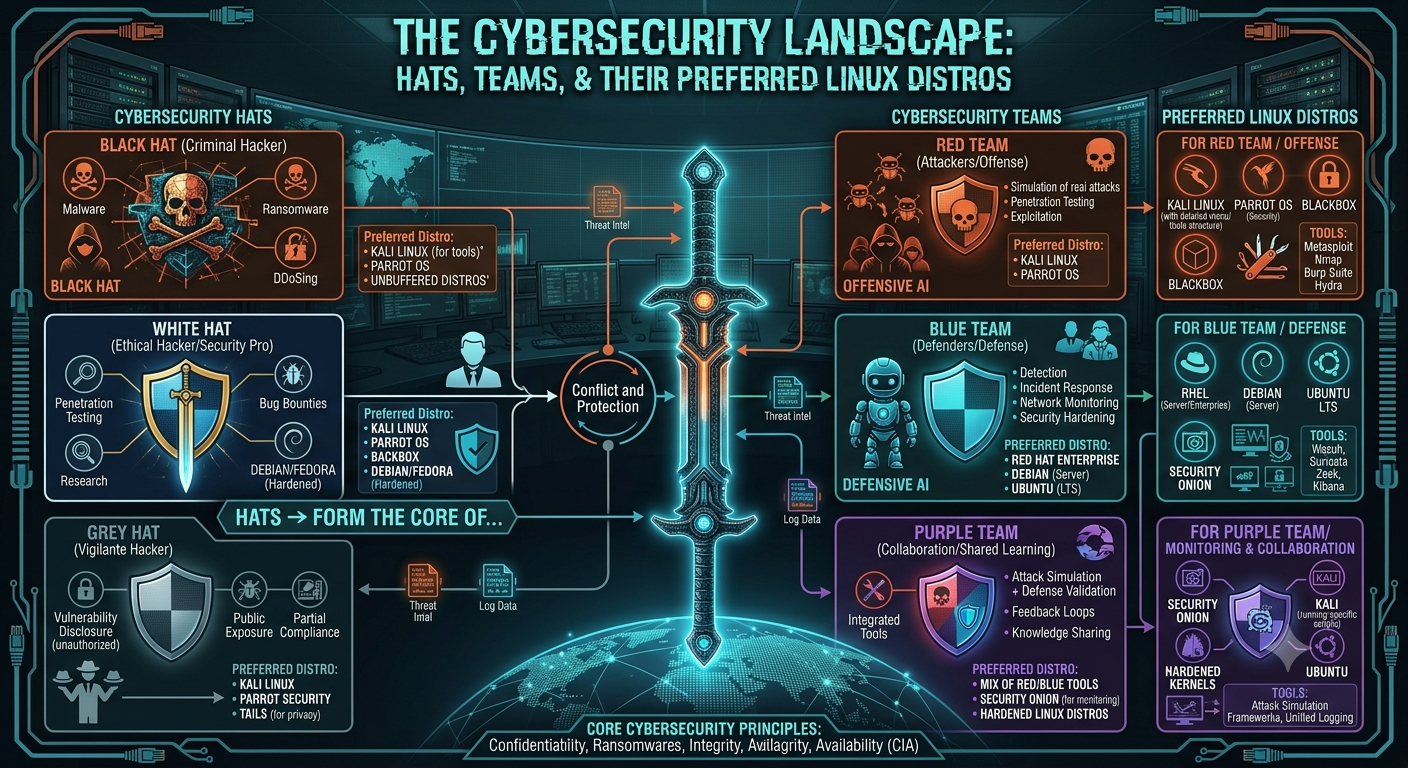
Types of Cybersecurity Hats, Cybersecurity Teams, and Their Preferred Linux
Types of Cybersecurity Hats, Cybersecurity Teams, and Their Preferred Linux Distributions
Cybersecurity is a broad field that has a wide range of professionals, each with unique responsibilities, ethical standards, and technical expertise. These professionals are often categorized by the “HATS” they wear, a metaphor that describes their intent and role when interacting with computer systems. Beyond individual roles, cybersecurity professionals typically work within specialized teams, each responsible for defending, testing, or responding to security threats. Since Linux is the dominant operating system in cybersecurity, different teams often favor different Linux distributions based on their workflow and requirements.
Types of Cybersecurity Hats
- White
- Black
- Gray
- Red
- Blue
- Green
White Hat Hackers
White hat hackers, also known as ethical hackers, are authorized security professionals who identify vulnerabilities before malicious actors can exploit them. Organizations hire white hats to perform penetration testing, vulnerability assessments, and security audits.
Their responsibilities include:
- Conducting penetration tests
- Assessing network security
- Reviewing application security
- Recommending remediation strategies
- Ensuring compliance with security standards
White hats work within legal and ethical boundaries and are often certified through programs such as Certified Ethical Hacker (CEH), Offensive Security Certified Professional (OSCP), or GIAC certifications.
Black Hat Hackers
Black hat hackers exploit vulnerabilities without permission for personal gain, espionage, or disruption. Their activities are illegal and include:
- Stealing sensitive information
- Deploying ransomware
- Creating malware
- Conducting phishing campaigns
- Selling stolen credentials
Black hat hackers continually develop new attack techniques, making them one of the primary adversaries cybersecurity professionals defend against.
Gray Hat Hackers
Gray hat hackers occupy a middle ground between white and black hats. They may access systems without authorization but typically do not intend to cause harm. Instead, they often disclose discovered vulnerabilities to organizations, sometimes requesting compensation.
Although their intentions may be beneficial, unauthorized testing remains illegal in many jurisdictions.
Red Hat Hackers
Red hat hackers specialize in tracking and disrupting malicious hackers. Rather than merely reporting cybercriminals, they actively work to neutralize their infrastructure or prevent future attacks. They are often associated with government agencies, military cyber units, or advanced threat-hunting organizations.
Blue Hat Hackers
The term “blue hat” has multiple meanings depending on the context.
In software development, blue hat hackers are invited external security testers who identify vulnerabilities before a product is released.
In defensive cybersecurity, blue hats may also refer to professionals who focus on protecting systems and monitoring infrastructure against attacks.
Green Hat Hackers
Green hat hackers are beginners entering cybersecurity. They possess a strong interest in hacking but have limited practical experience. They spend significant time learning:
- Networking fundamentals
- Linux administration
- Programming
- Web security
- Operating system internals
Most cybersecurity professionals begin as green hats before developing specialized expertise.
Cybersecurity Teams
- Blue
- Red
- Purple
- SOC
- IR
- TI
Modern organizations rely on multiple cybersecurity teams that work together to reduce risk and respond to incidents.
Blue Team
The Blue Team is responsible for defense.
Its responsibilities include:
- Security monitoring
- Log analysis
- Threat detection
- Endpoint protection
- Patch management
- Security hardening
- Incident response
Blue Team professionals continuously monitor networks for suspicious behavior and respond to attacks before they spread.
Red Team
The Red Team simulates real-world attacks against an organization.
Their objectives include:
- Testing security controls
- Evaluating employee awareness
- Assessing physical security
- Simulating advanced persistent threats (APTs)
- Identifying weaknesses before attackers do
Unlike vulnerability scanning, Red Team engagements often mimic sophisticated adversaries over extended periods.
Purple Team
The Purple Team bridges the gap between Red and Blue Teams.
Instead of operating independently, Purple Teams facilitate collaboration by ensuring that:
- Red Team findings improve Blue Team defenses
- Detection rules are updated
- Defensive capabilities are validated
- Lessons learned are shared across teams
Purple Teaming significantly improves an organization’s security maturity.
SOC (Security Operations Center)
The Security Operations Center operates around the clock to detect and respond to cyber threats.
SOC analysts typically perform:
- Continuous monitoring
- Alert triage
- Threat hunting
- Malware analysis
- Incident escalation
- Security reporting
SOC teams are usually organized into Tier 1, Tier 2, and Tier 3 analysts based on experience and responsibilities.
Incident Response Team
Incident Response (IR) teams specialize in handling active security incidents.
Their process generally follows these stages:
- Preparation
- Detection
- Containment
- Eradication
- Recovery
- Lessons learned
Their goal is to minimize business disruption while preserving forensic evidence.
Threat Intelligence Team
Threat Intelligence teams collect and analyze information about emerging cyber threats.
They study:
- Malware campaigns
- Nation-state actors
- Cybercriminal groups
- Indicators of compromise (IOCs)
- Tactics, Techniques, and Procedures (TTPs)
The intelligence they produce helps organizations anticipate and prepare for future attacks.
Preferred Linux Distributions
Linux is the preferred operating system for many cybersecurity professionals because of its flexibility, open-source ecosystem, and extensive security tools. Different teams often choose different distributions based on their needs.
Kali Linux
Kali Linux is the most recognized penetration-testing distribution.
Preferred by:
- Red Teams
- Ethical hackers
- Penetration testers
- Security researchers
Reasons include:
- Hundreds of pre-installed security tools
- Regular updates
- Excellent hardware compatibility
- Extensive documentation
- Large community support
Common tools include Nmap, Metasploit Framework, Burp Suite Community Edition, Wireshark, Aircrack-ng, Hydra, John the Ripper, and SQLmap.
Parrot Security OS
Parrot Security OS offers a lightweight alternative focused on penetration testing, privacy, and development.
Preferred by:
- Ethical hackers
- Privacy researchers
- Bug bounty hunters
- Developers
Advantages include:
- Lower resource usage
- Privacy-focused utilities
- Development tools
- Secure default configuration
BlackArch Linux
BlackArch is an Arch Linux–based distribution containing thousands of security tools.
Preferred by:
- Advanced penetration testers
- Experienced Linux users
- Researchers
Its rolling-release model ensures access to the latest software but requires greater familiarity with Linux system administration.
Ubuntu
Ubuntu is widely used for defensive security operations.
Preferred by:
- Blue Teams
- SOC analysts
- Security engineers
- Cloud administrators
Reasons include:
- Stability
- Long-Term Support (LTS) releases
- Large software repositories
- Excellent server support
- Strong enterprise adoption
Many organizations deploy Ubuntu servers to host security monitoring tools, SIEM platforms, and logging infrastructure.
Debian
Debian is known for exceptional stability and reliability.
Preferred by:
- Security infrastructure teams
- Server administrators
- Incident response environments
Because packages are thoroughly tested, Debian is an excellent choice for production security systems where reliability is critical.
Fedora
Fedora provides access to newer software and security technologies.
Preferred by:
- Security developers
- Researchers
- SELinux experts
Fedora integrates cutting-edge Linux features while maintaining strong security defaults.
Arch Linux
Arch Linux is favored by users who prefer complete control over their environment.
Preferred by:
- Experienced security researchers
- Malware analysts
- Reverse engineers
Its minimal installation allows professionals to build highly customized systems tailored to specific workflows.
Choosing the Right Distribution
No single Linux distribution is ideal for every cybersecurity role. Red Teams typically prioritize offensive tools, making Kali Linux or Parrot Security OS popular choices. Blue Teams often prefer stable server-oriented distributions such as Ubuntu or Debian to support monitoring and defense. Researchers and advanced users may choose BlackArch or Arch Linux for their flexibility and extensive customization options.
Ultimately, the effectiveness of a cybersecurity professional depends less on the operating system they use and more on their understanding of networking, operating systems, programming, security principles, and continuous learning.
Conclusion
Cybersecurity is a multidisciplinary profession requiring collaboration among specialists with diverse skills and responsibilities. The “hat” classifications help describe ethical intent, while organizational teams such as Red, Blue, Purple, SOC, Incident Response, and Threat Intelligence each play a distinct role in protecting digital assets. Linux distributions further support these teams by providing environments optimized for offensive testing, defensive operations, research, or enterprise deployment. As cyber threats continue to evolve, both technical expertise and the right tools remain essential for maintaining resilient and secure systems.