
OWASP Top 10 Vulnerabilities Explained – Complete Guide for Beginners
OWASP Top 10 Vulnerabilities Explained
Web applications power everything from online banking and e-commerce to healthcare portals and business management systems. As organizations increasingly rely on web-based applications, attackers continue searching for weaknesses that can be exploited to steal sensitive data, disrupt services, or gain unauthorized access.
One of the most trusted resources for improving web application security is the OWASP Top 10. Published by the Open Worldwide Application Security Project (OWASP), this list identifies the most critical security risks affecting web applications. Developers, security professionals, penetration testers, and organizations around the world use it as a foundation for building secure software and reducing cyber risks.
Understanding these vulnerabilities is essential for anyone involved in software development or cybersecurity. In this guide, we’ll explain each category from the latest OWASP Top 10 list, discuss how attackers exploit these weaknesses, and provide practical recommendations to reduce your organization’s exposure.
What Is OWASP?
OWASP (Open Worldwide Application Security Project) is a non-profit organization dedicated to improving software security. It provides free resources, tools, documentation, and educational materials that help developers build more secure applications.
Some of OWASP’s most popular projects include:
- OWASP Top 10
- OWASP Web Security Testing Guide
- OWASP ASVS (Application Security Verification Standard)
- OWASP Cheat Sheet Series
- OWASP Dependency-Check
- OWASP ZAP (Zed Attack Proxy)
These resources are widely recognized across the cybersecurity industry and are frequently referenced in security training and compliance programs.
What Is the OWASP Top 10?
The OWASP Top 10 is a regularly updated awareness document that highlights the ten most significant security risks affecting modern web applications. Rather than listing every possible vulnerability, it focuses on the issues that are both common and capable of causing serious damage if left unaddressed.
Organizations use the OWASP Top 10 to:
- Improve secure software development
- Train developers and security teams
- Perform security assessments
- Reduce application security risks
- Meet compliance and regulatory expectations
Because the threat landscape changes over time, OWASP periodically updates the list based on industry data and expert input.
1. Broken Access Control
Broken Access Control occurs when users can perform actions or access resources beyond the permissions assigned to them.
Instead of enforcing proper authorization, an application may allow attackers to view confidential information, modify records, or perform administrative actions.
Examples
- Accessing another user’s account by changing an ID in the URL
- Viewing confidential files without authorization
- Editing or deleting records belonging to other users
- Bypassing administrative restrictions
Potential Impact
- Data breaches
- Unauthorized transactions
- Privilege escalation
- Loss of customer trust
Prevention
- Enforce server-side authorization checks
- Follow the principle of least privilege
- Deny access by default
- Validate permissions for every request
- Perform regular access-control testing
2. Cryptographic Failures
Previously known as Sensitive Data Exposure, this category focuses on failures in protecting sensitive information through proper encryption.
Many organizations incorrectly store or transmit sensitive information such as:
- Passwords
- Credit card numbers
- Medical records
- Personal identification information
- Financial data
Weak encryption or poor key management allows attackers to steal valuable information.
Common Causes
- Using outdated encryption algorithms
- Weak SSL/TLS configurations
- Storing passwords in plain text
- Improper key management
- Missing HTTPS
Prevention
- Use modern encryption standards
- Encrypt sensitive information at rest and in transit
- Hash passwords using secure algorithms
- Implement strong TLS configurations
- Regularly rotate encryption keys
3. Injection
Injection vulnerabilities occur when untrusted user input is interpreted as commands by an application.
One of the most well-known examples is SQL Injection, where attackers manipulate database queries to access or modify sensitive information.
Other forms include:
- SQL Injection
- Command Injection
- LDAP Injection
- NoSQL Injection
- XML Injection
Example Scenario
A login form accepts user input without proper validation. An attacker submits specially crafted SQL code that bypasses authentication and gains unauthorized access to the database.
Risks
- Database compromise
- Remote code execution
- Data theft
- Account takeover
Prevention
- Use parameterized queries
- Validate and sanitize user input
- Avoid dynamic query construction
- Apply least-privilege database permissions
- Use secure frameworks with built-in protections
4. Insecure Design
Insecure Design refers to weaknesses that originate during the planning and architecture phases of software development rather than coding mistakes alone.
Even well-written code can become vulnerable if the application lacks proper security design.
Examples
- Missing rate limiting
- Weak authentication workflows
- Poor password recovery processes
- Inadequate business logic validation
Prevention
- Integrate security into the Software Development Life Cycle (SDLC)
- Perform threat modeling
- Conduct architecture reviews
- Apply secure design principles
- Test business logic before deployment
5. Security Misconfiguration
Security Misconfiguration remains one of the most common causes of successful cyberattacks.
Applications often become vulnerable due to incorrect settings, unnecessary features, or insecure default configurations.
Common Examples
- Default administrator credentials
- Publicly accessible cloud storage
- Debug mode enabled in production
- Unpatched software
- Open ports and unnecessary services
Risks
- Unauthorized access
- Information disclosure
- System compromise
- Malware infections
Prevention
- Remove unnecessary services
- Disable default accounts
- Apply security patches promptly
- Harden server configurations
- Regularly audit security settings
Why Developers Should Care About the OWASP Top 10
Ignoring application security can have serious consequences. A single exploited vulnerability may result in:
- Financial losses
- Regulatory penalties
- Customer data breaches
- Business disruption
- Reputation damage
- Legal consequences
Developers who understand the OWASP Top 10 are better equipped to write secure code, identify potential weaknesses early, and reduce the overall attack surface of their applications.
Modern secure development practices begin with awareness, and the OWASP Top 10 provides an excellent roadmap for building safer software.
6. Vulnerable and Outdated Components
Modern applications rely heavily on third-party libraries, frameworks, plugins, and software packages. While these components speed up development, they can also introduce security risks if they are outdated or contain known vulnerabilities.
Cybercriminals frequently scan websites and applications for software running outdated versions with publicly disclosed security flaws.
Common Examples
- Outdated content management systems (CMS)
- Old JavaScript libraries
- Unsupported PHP versions
- Unpatched web servers
- Vulnerable open-source packages
Risks
- Remote code execution
- Data theft
- Website defacement
- Malware infections
- Full server compromise
Prevention
- Maintain an inventory of software components.
- Remove unused libraries and plugins.
- Apply security patches promptly.
- Use supported software versions.
- Perform regular vulnerability scans.
- Monitor security advisories for dependencies.
7. Identification and Authentication Failures
Authentication ensures that users are who they claim to be. Weak authentication mechanisms allow attackers to compromise user accounts through password attacks, session hijacking, or credential theft.
Common Causes
- Weak password policies
- Password reuse
- Missing Multi-Factor Authentication (MFA)
- Predictable session IDs
- Insecure password reset processes
Risks
- Account takeover
- Unauthorized access
- Identity theft
- Financial fraud
Prevention
- Enforce strong password policies.
- Enable Multi-Factor Authentication (MFA).
- Limit failed login attempts.
- Use secure session management.
- Store passwords using strong hashing algorithms.
- Monitor for suspicious login activity.
8. Software and Data Integrity Failures
Software and Data Integrity Failures occur when applications fail to verify the integrity of software updates, code, or data before using them. Attackers can exploit these weaknesses to inject malicious code or manipulate trusted software.
This risk has become increasingly important due to software supply chain attacks.
Examples
- Unsigned software updates
- Compromised software repositories
- Insecure CI/CD pipelines
- Malicious package dependencies
- Insecure deserialization
Risks
- Malware distribution
- Remote code execution
- Supply chain compromise
- Data manipulation
Prevention
- Digitally sign software updates.
- Verify package integrity before installation.
- Protect CI/CD pipelines.
- Restrict deployment permissions.
- Validate third-party dependencies.
- Continuously monitor software changes.
9. Security Logging and Monitoring Failures
Many organizations fail to detect cyberattacks because they lack effective logging and monitoring systems. Without detailed logs, security teams may not notice suspicious activity until significant damage has occurred.
Examples
- Missing login logs
- No failed authentication alerts
- Lack of audit trails
- Inadequate incident monitoring
- Failure to review security events
Risks
- Delayed breach detection
- Longer attacker dwell time
- Difficult forensic investigations
- Regulatory compliance issues
Prevention
- Enable detailed security logging.
- Monitor authentication events.
- Centralize logs using SIEM solutions.
- Configure real-time alerts.
- Regularly review audit logs.
- Develop an incident response plan.
10. Server-Side Request Forgery (SSRF)
Server-Side Request Forgery (SSRF) allows attackers to trick a server into making requests on their behalf. Instead of directly attacking internal systems, attackers exploit the application’s server to access resources that are normally inaccessible.
Common Examples
- Accessing internal APIs
- Retrieving cloud metadata
- Scanning internal networks
- Bypassing firewalls
- Accessing restricted services
Risks
- Internal network exposure
- Cloud credential theft
- Data leakage
- Remote exploitation
Prevention
- Validate all user-supplied URLs.
- Restrict outbound network requests.
- Use allowlists for approved destinations.
- Disable unnecessary protocols.
- Segment internal networks.
- Monitor unusual outbound traffic.
Best Practices for Preventing OWASP Top 10 Vulnerabilities
Reducing application security risks requires a proactive approach throughout the software development lifecycle.
Follow Secure Coding Practices
Developers should use secure programming techniques, validate user input, and avoid introducing unnecessary security risks into applications.
Keep Software Updated
Regularly update operating systems, frameworks, plugins, libraries, and third-party components to address known vulnerabilities.
Perform Regular Security Testing
Combine automated vulnerability scanning with manual penetration testing to identify weaknesses before attackers do.
Implement Strong Authentication
Use strong password policies, enable Multi-Factor Authentication (MFA), and apply the principle of least privilege to reduce unauthorized access.
Encrypt Sensitive Data
Protect sensitive information both in transit and at rest using modern encryption standards and secure key management.
Conduct Security Training
Developers, administrators, and employees should receive ongoing cybersecurity training to stay informed about evolving threats and secure development practices.
Monitor and Respond to Incidents
Implement centralized logging, continuous monitoring, and an incident response plan to quickly detect and contain potential security incidents.
Why the OWASP Top 10 Is Important
The OWASP Top 10 serves as a practical guide for organizations looking to strengthen application security. It helps teams prioritize the most critical risks, improve secure development practices, and reduce the likelihood of successful cyberattacks.
Benefits include:
- Improved application security
- Better developer awareness
- Reduced attack surface
- Stronger compliance with industry standards
- Lower risk of costly data breaches
- Enhanced customer trust
Whether you are building a small business website or a large enterprise application, understanding these vulnerabilities is essential for creating secure software.
Frequently Asked Questions (FAQs)
What is the OWASP Top 10?
The OWASP Top 10 is a regularly updated list of the most critical web application security risks, published by the Open Worldwide Application Security Project (OWASP).
Who should learn the OWASP Top 10?
Software developers, cybersecurity professionals, penetration testers, DevSecOps engineers, IT administrators, and students can all benefit from understanding the OWASP Top 10.
How often is the OWASP Top 10 updated?
OWASP updates the list periodically based on industry research, vulnerability data, and expert feedback to reflect the evolving threat landscape.
Does the OWASP Top 10 apply only to websites?
No. While it focuses on web application security, the principles also apply to APIs, cloud-native applications, mobile backends, and many modern software systems.
Can small businesses benefit from the OWASP Top 10?
Yes. Small businesses are increasingly targeted by cybercriminals. Following OWASP recommendations helps improve security regardless of organization size.
Conclusion
The OWASP Top 10 Vulnerabilities represent the most significant security risks affecting modern web applications. From Broken Access Control and Injection attacks to Security Misconfiguration and Server-Side Request Forgery (SSRF), each vulnerability highlights common weaknesses that attackers exploit to gain unauthorized access, steal sensitive data, or disrupt business operations.
Understanding these risks is only the first step. Organizations should adopt secure coding practices, perform regular security testing, keep software updated, implement strong authentication, and continuously monitor their applications for suspicious activity. Integrating security into every stage of the Software Development Life Cycle (SDLC) reduces vulnerabilities before they reach production and creates more resilient applications.
Whether you are a developer, security professional, or business owner, using the OWASP Top 10 as a security framework will help strengthen your defenses, protect user data, and reduce the likelihood of costly cyberattacks.
Suggested Internal Links
- What Is Ethical Hacking?
- Multi-Factor Authentication (MFA): Complete Guide
- Password Security Best Practices for Businesses
- File Integrity Monitoring: Why It Matters
- SQL Injection Explained
- Cross-Site Scripting (XSS): Prevention Guide
Recommended WordPress Category
Cybersecurity
Suggested Tags
- OWASP Top 10
- Web Application Security
- Cybersecurity
- Secure Coding
- Penetration Testing
- SQL Injection
- Broken Access Control
- SSRF
- Application Security
- DevSecOps
SEO Excerpt
Learn the OWASP Top 10 web application security vulnerabilities with this beginner-friendly guide. Discover how these risks work, why they matter, and the best practices to protect your applications from cyber threats.
Image Alt Text
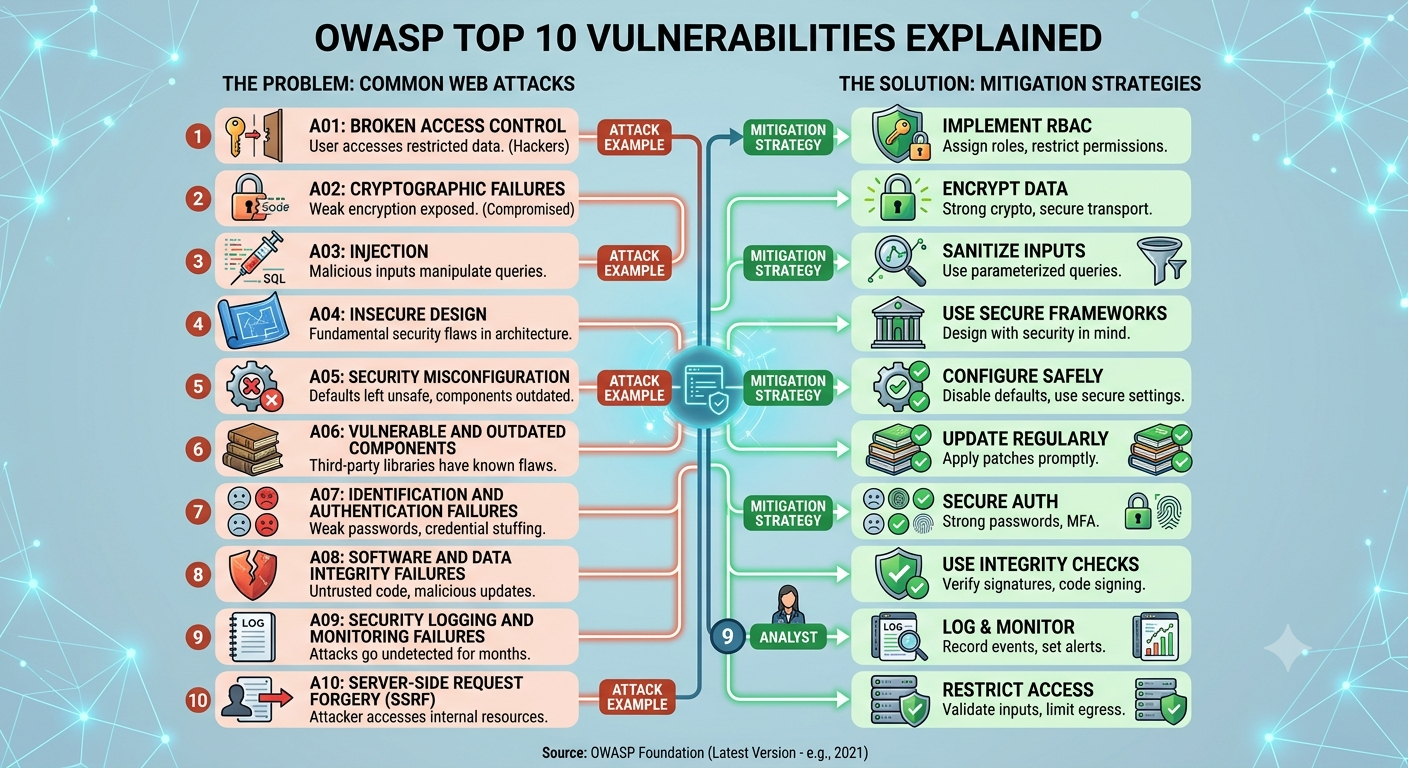
“Infographic illustrating the OWASP Top 10 web application security vulnerabilities with icons representing common cyber threats.”
Keyword Placement Summary
Primary Keyword: OWASP Top 10 Vulnerabilities
Naturally included in:
- SEO title
- Meta description
- URL slug
- Introduction
- Section headings
- Body content
- Conclusion
- FAQ section
- SEO excerpt
- Image alt text
This structure follows SEO best practices while maintaining a natural, reader-friendly flow and avoiding keyword stuffing.