
Ethical Hacking Explained: Everything You Need to Know
Ethical Hacking Explained: Everything You Need to Know

In an age when our lives revolve around technology, cybersecurity is more important than ever. Data breaches, identity theft, ransomware, and digital espionage are daily headlines. But did you know that the same skills hackers use to break into systems can also be wielded to protect them? This is the world of ethical hacking—where hackers wear a “white hat” and use their powers for good.
Let’s explore what ethical hacking really is, how it works, who does it, and why it’s essential for modern businesses and individuals.
What Is Ethical Hacking?
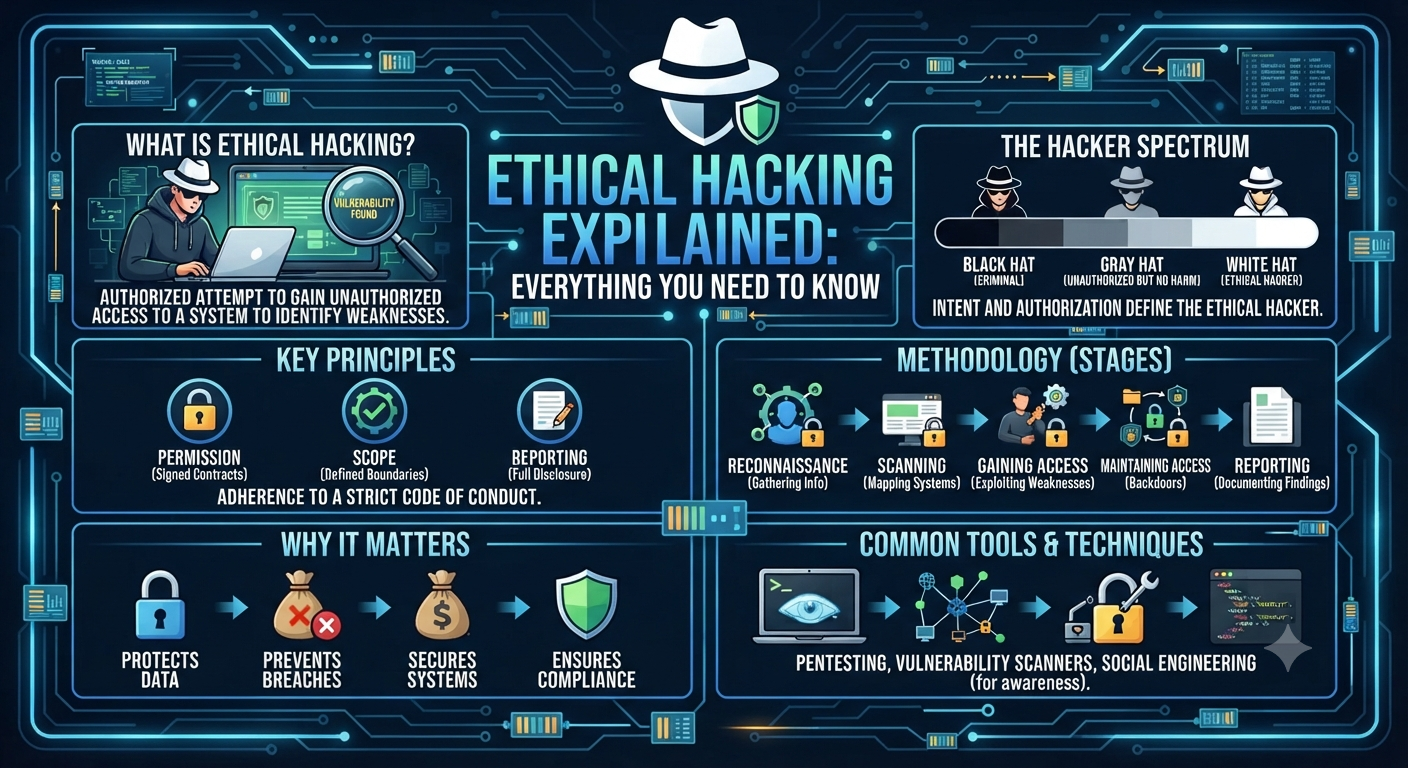
Ethical hacking, sometimes called penetration testing or white-hat hacking, is the process of legally breaking into computers and devices to test an organization’s defenses. An ethical hacker’s mission is to find vulnerabilities before the bad guys do.
In simple terms:
Ethical hackers use their expertise to help organizations discover security flaws, fix them, and ultimately protect data, assets, and reputation.
Analogy: Imagine hiring a skilled burglar to try to break into your house—so you know if your locks are strong enough. That’s what ethical hackers do, but in the digital world.
Why Is Ethical Hacking Important?
Hackers are constantly scanning the internet, looking for easy targets. No system is 100% secure. Even the world’s largest companies—with armies of security experts—fall victim to cyberattacks.
Ethical hacking helps by:
- Identifying weaknesses before criminals do
- Preventing data breaches, ransomware, and financial losses
- Meeting regulatory requirements (like GDPR, HIPAA, PCI DSS)
- Building trust with customers and partners
- Improving the overall health of digital infrastructure
Types of Ethical Hackers

1. White Hat Hackers:
These are the “good guys.” They have permission to hack systems and report findings to help organizations.
2. Black Hat Hackers:
The criminals. They break into systems illegally for personal gain, theft, or sabotage.
3. Gray Hat Hackers:
These hackers operate in a gray area—sometimes breaking rules but without malicious intent. They might discover vulnerabilities and disclose them publicly, rather than reporting to the company.
Ethical hacking is strictly “white hat.” Only authorized professionals, operating under clear rules and contracts, can call themselves ethical hackers.
The Legal Side: Permission Is Everything
A crucial difference between ethical and unethical hacking is authorization. Ethical hackers always operate with explicit, written permission.
Legal protections:
- Contracts specify what systems can be tested, the scope, and what’s off-limits.
- Responsible disclosure policies ensure vulnerabilities are reported privately and fixed.
- Violating these boundaries—even with good intentions—can lead to prosecution.
The Five Phases of Ethical Hacking
Ethical hacking isn’t just about running scripts or guessing passwords. It’s a structured, methodical process, often broken into these five phases:
1. Reconnaissance (Information Gathering)
This is like digital detective work. The hacker collects as much information as possible about the target:
- IP addresses and domains
- Employee names and emails
- Software and hardware in use
- Publicly available data (social media, job postings, etc.)
Tools: Google Dorking, WHOIS, Maltego, Shodan
2. Scanning
Here, ethical hackers probe the target for weaknesses.
- Scanning for open ports
- Identifying vulnerable services
- Mapping the network
Tools: Nmap, Nessus, OpenVAS, Nikto
3. Gaining Access
This is the actual “break-in.” Using information from the previous steps, hackers attempt to exploit vulnerabilities—like outdated software, weak passwords, or misconfigurations.
- SQL injection
- Cross-site scripting (XSS)
- Password attacks
Tools: Metasploit, Hydra, Burp Suite
4. Maintaining Access
A real attacker wouldn’t just get in—they’d try to stay undetected, creating “backdoors” for future access.
Ethical hackers simulate this to see if security monitoring and response are strong enough.
5. Covering Tracks
Professional hackers erase logs and hide evidence to avoid detection. Ethical hackers may test these tactics to ensure security teams can still spot suspicious activity.
6. Reporting
The most important step! Ethical hackers provide a detailed, actionable report:
- What was tested
- Vulnerabilities found
- Proof of concept (how the breach happened)
- Steps to fix the issues
Common Techniques and Tools Used by Ethical Hackers
Some popular methods:
- Social Engineering: Tricking people into revealing passwords or sensitive info (e.g., phishing emails)
- Password Cracking: Guessing or brute-forcing weak passwords
- Vulnerability Scanning: Automated checks for known software flaws
- Network Sniffing: Capturing data packets to analyze sensitive communications
- Web Application Attacks: Exploiting flaws in websites or web apps
Popular Tools:
- Kali Linux: The ultimate ethical hacking operating system, packed with hundreds of tools
- Metasploit: A framework for developing and executing exploit code
- Burp Suite: For web application security testing
- Wireshark: For network analysis
- John the Ripper: Password cracking
- Aircrack-ng: Wireless network testing
Real-World Examples of Ethical Hacking
1. Facebook Bug Bounty:
Facebook runs a public program that pays ethical hackers to find and report vulnerabilities. In 2022, they paid millions in rewards—helping keep users safe.
2. Penetration Testing for Banks:
Banks routinely hire ethical hackers to simulate attacks, ensuring their defenses can withstand real-world threats.
3. Major Government Audits:
Governments employ “red teams” of ethical hackers to test the security of public infrastructure, from power grids to election systems.
Becoming an Ethical Hacker: Skills and Certifications

Key skills:
- Deep knowledge of operating systems (Windows, Linux, macOS)
- Understanding of networks and protocols (TCP/IP, DNS, HTTP, etc.)
- Proficiency in programming/scripting (Python, Bash, PowerShell)
- Knowledge of web technologies and databases
- Ability to think creatively (and like a hacker)
Top certifications:
- CEH (Certified Ethical Hacker): One of the most recognized entry-level certs
- OSCP (Offensive Security Certified Professional): Highly respected, hands-on penetration testing
- CPT (Certified Penetration Tester)
- CompTIA Security+ and Pentest+
Ethical Hacking Careers
Job roles:
- Penetration Tester (Pen Tester)
- Security Consultant
- Red Team Member
- Security Analyst
- Vulnerability Researcher
- Application Security Engineer
Industries hiring ethical hackers:
- Tech companies
- Financial institutions
- Healthcare providers
- Government agencies
- Cybersecurity firms
- Consulting companies
Demand is huge: As cybercrime grows, companies are eager to hire people who can “think like a hacker” but act ethically.
Challenges and Limitations
Ethical hacking isn’t all fun and games. There are real challenges:
- Constantly Evolving Threats: Attackers invent new tactics daily.
- Legal and Ethical Boundaries: One mistake can land you in legal trouble.
- Complex Systems: Modern IT environments are vast and complicated.
- Time and Resource Constraints: Testing every aspect of a large company is difficult.
How to Get Started with Ethical Hacking
- Learn the Basics: Study networking, operating systems, and basic cybersecurity.
- Practice: Use legal platforms like Hack The Box or TryHackMe.
- Earn Certifications: Start with CEH or CompTIA Security+, then move up.
- Join the Community: Participate in Capture The Flag (CTF) competitions, forums, and bug bounty programs.
- Stay Ethical: Always get permission. Never hack without explicit authorization.
The Importance of Responsible Disclosure
If you find a vulnerability, report it privately to the organization—never publish it online first. Many companies have bug bounty programs that reward responsible disclosure. This keeps users safe and helps organizations fix issues before hackers exploit them.
The Future of Ethical Hacking

As technology evolves, so does ethical hacking. The next wave includes:
- AI-powered attacks and defenses
- Internet of Things (IoT) hacking
- Cloud security testing
- Mobile and app-specific hacking
- Supply chain security assessments
Ethical hackers must keep learning and adapting—just like their adversaries.
Final Thoughts
Ethical hacking is more than a job; it’s a responsibility. By using hacker skills for good, ethical hackers protect companies, governments, and everyday people from harm. They are the unsung heroes of our digital world—always one step ahead of the bad guys.
Whether you dream of becoming an ethical hacker or just want to better protect yourself online, understanding how hackers think is the first step to staying safe.
Remember: In cybersecurity, knowledge is power, and ethical hacking is the force for good.